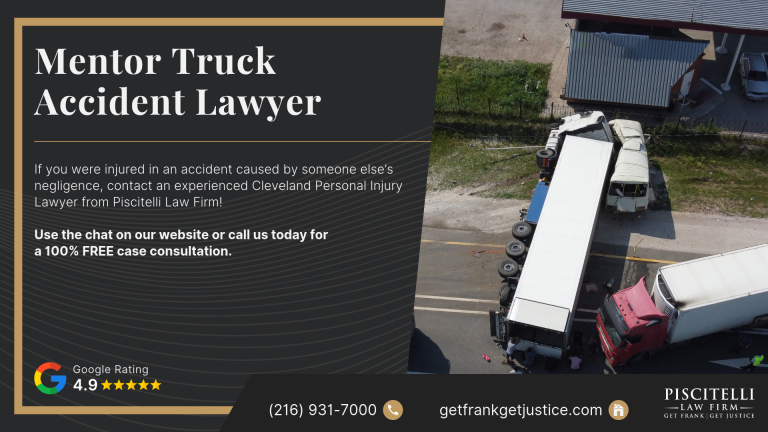
No fees unless we win.
Get a free consultation
•
72 Reviews
4.8
★★★★★

Mentor Truck Accident Lawyer | Call (216) 931-7000

Mentor Truck Accident Lawyer: Speak With Frank Piscitelli

Piscitelli Law Firm handles truck accident cases involving tractor-trailers, delivery trucks, dump trucks, and other commercial vehicles in Mentor and throughout Northeast Ohio.

Commercial truck accidents can cause severe injuries and involve complex questions about driver negligence, trucking company responsibility, federal safety regulations, and insurance coverage.

Frank Piscitellihas more than 30 years of legal experience and personally directs the cases our law firm accepts.

A truck accident lawyer can help evaluate the circumstances of a collision, identify potentially responsible parties, and assess the compensation available for medical expenses, lost income, and other damages.

Our law firm offers free consultations to discuss your legal options and the possibility of pursuing full compensation for losses caused by another party’s negligence.

10 Ohio Truck Accident Lawyer FAQs Answered by Injury Law Firm YouTube Thumbnail

Our Law Firm Handles Truck Accident Cases in Mentor, OH

Piscitelli Law Firm represents people injured in commercial truck accidents throughout Mentor, Lake County, and Northeast Ohio.

Truck accident claims often involve serious injuries, substantial financial losses, and complex liability questions involving truck drivers, motor carriers, and other businesses.

Federal trucking regulations, commercial insurance policies, and company records may also play an important role in determining responsibility and pursuing compensation.

Frank Piscitelli is a personal injury lawyer with more than 30 years of experience representing Ohio injury and wrongful death clients, including people hurt in serious motor vehicle accidents.

As the sole attorney at our law firm, Frank maintains a limited caseload and personally directs important legal decisions for the clients he represents.

From our Mentor office at 7200 Center Street, Suite 312, we offer free consultations and handle qualifying truck accident claims on a contingency fee basis, with no attorney fees unless compensation is recovered.

Any responsibility for case expenses is explained in the written agreement.

Mentor Truck Accident Lawyer; Meet Frank Piscitelli_ One of Cleveland's Top Truck Accident Attorneys; What To Do After a Truck Accident in Mentor, OH; Gather Evidence for Your Truck Accident Claim; Common Truck Accident Injuries; The Legal Process for Truck Accident Cases in Ohio; Common Causes of Truck Accidents; Common Damages in Truck Accident Claims; Who Can Be Held Liable in a Truck Accident Case; The Piscitelli Law Firm_ Your Mentor Truck Accident Lawyer

Why Choose Frank Piscitelli for a Truck Accident Claim?

Frank Piscitelli brings more than 30 years of experience representing Ohio personal injury and wrongful death clients, including people injured in serious motor vehicle accidents.

Throughout his career, Frank has handled cases involving disputed liability, complex insurance issues, and substantial medical and financial losses.

Our law firm has recovered more than $55 million for injured Ohioans and their families across prior cases, although past results do not guarantee future outcomes.

Unlike larger firms where clients may work with several attorneys, Frank maintains a limited caseload and personally directs case strategy, settlement decisions, and trial preparation.

Clients communicate directly with Frank about important legal matters, while our staff provides administrative support with scheduling, documentation, and case communications.

His approach combines individualized representation with the litigation experience needed to address contested injury claims and pursue compensation supported by the evidence.

Who Can Be Held Liable for a Truck Accident in Mentor?

A collision between a large truck and a passenger car may involve multiple parties when negligent driving, improper maintenance, or unsafe cargo practices contribute to the crash.

Depending on their conduct and legal responsibilities, potentially liable parties include:

  • Truck driver: Negligent driving, including unsafe speed, distraction, impaired driving, or failure to yield.
  • Motor carrier or trucking company: Responsibility for a driver’s conduct or the company’s own failures in qualification, supervision, scheduling, inspection, or maintenance.
  • Maintenance contractor: Negligent repairs or inspections that contributed to an equipment failure.
  • Cargo loader or shipper: Improper loading or other actionable conduct that caused cargo to shift or fall.
  • Freight broker: Negligent selection of an unsafe motor carrier when the applicable legal requirements are met.
  • Vehicle or component manufacturer: A legally actionable design, manufacturing, or warning defect that caused or worsened the injuries.

The tractor owner, trailer owner, leasing company, or another motorist may also be relevant when there is a supported basis for liability.

Ownership records, contracts, dispatch communications, inspection documents, and witness accounts may help establish who performed particular tasks and whether that conduct caused the accident.

To determine liability, each potentially responsible party’s legal duties and contribution to the collision must be assessed separately.

When May a Trucking Company Be Responsible?

A motor carrier may face liability when a driver acting within the scope of employment negligently causes a crash or when the company’s own actions contribute to the harm.

Relevant issues can include whether a driver was qualified, whether the company maintained safe equipment, and whether a schedule or supervisory decision contributed to unsafe operation.

The legal analysis may differ when a truck is leased, a driver is an independent contractor, or several businesses participate in a single shipment.

For this reason, the name printed on the truck or listed in shipping paperwork is a starting point for identifying involved parties, not conclusive proof of responsibility.

Can a Freight Broker Be Liable for Selecting an Unsafe Carrier?

Freight brokers arrange shipments by hiring trucking companies to transport goods, but they may share responsibility for accidents when they select carriers with serious safety problems.

In May 2026, the U.S. Supreme Court ruled in Montgomery v. Caribe Transport II, LLC that federal law does not automatically prevent injured people from suing brokers for carelessly hiring unsafe trucking companies.

A broker may be held liable if it failed to exercise reasonable care when selecting a carrier and that decision contributed to the accident.

Past safety violations, inspection records, and communications between the broker and trucking company may help establish whether the broker overlooked warning signs before arranging the shipment.

Federal Trucking Regulations That May Affect Your Claim

Truck accident law involves both Ohio negligence principles and federal regulations governing the trucking industry.

The Federal Motor Carrier Safety Administration (FMCSA) establishes requirements for driver qualifications, operating hours, vehicle maintenance, cargo securement, and insurance coverage.

Unlike ordinary car accidents, commercial truck claims may require examining whether a motor carrier violated applicable safety requirements.

An experienced truck accident attorney can help identify which regulations apply and what records may establish whether a violation contributed to the collision.

Federal trucking safety requirements address several potential causes of commercial vehicle accidents:

  • Driver fatigue: Federal hours-of-service rules generally limit covered property-carrying drivers to 11 hours of driving after 10 consecutive hours off duty, within a 14-hour driving window, subject to exceptions.
  • Driver qualifications: Trucking companies must verify that covered drivers meet licensing and qualification requirements and maintain required employment and driving records.
  • Vehicle maintenance: Motor carriers must inspect, repair, and maintain covered commercial trucks, including brakes, tires, wheel assemblies, and steering systems, to address defects that could contribute to accidents.
  • Cargo securement: Federal rules require covered trucks to carry properly secured cargo to prevent shifting loads, falling freight, and vehicle instability.
  • Commercial insurance: Under 49 CFR § 387.9, for-hire interstate carriers transporting nonhazardous property in vehicles rated at 10,001 pounds or more generally must maintain at least $750,000 in public-liability coverage, with higher minimums for certain hazardous materials.

These requirements vary depending on the vehicle, cargo, and type of commercial operation.

Driver logs, inspection reports, maintenance records, and cargo documents can help establish whether safety violations contributed to a collision.

Federal insurance requirements may also affect the coverage available to injured victims, although required policy minimums do not guarantee a particular recovery.

How Can Evidence Be Preserved After a Commercial Truck Crash?

Tractor-trailers and other commercial vehicles may be repaired or returned to service before an injury claim is resolved, and some electronic information may be overwritten during ordinary operations.

A preservation request can identify relevant records or physical equipment and notify a company that the material should be retained in anticipation of litigation.

These notices are sometimes called spoliation letters, and they may be sent to trucking companies or other evidence holders when litigation is reasonably anticipated.

Depending on the crash, important evidence may include:

  • The tractor, trailer, damaged components, and involved passenger vehicles.
  • Dashcam footage, electronic control module data, and GPS records.
  • ELD records, dispatch messages, and delivery documentation.
  • Driver qualification and training records.
  • Inspection reports, maintenance histories, and repair records.
  • Cargo photographs, loading records, and bills of lading.
  • Witness accounts, scene photographs, and the investigating agency’s report.

The information needed in a fatigue case may differ substantially from the records needed when defective brakes or improperly secured freight are suspected.

Some trucking cases call for accident reconstructionists, mechanical engineers, or industry experts to interpret data and examine the events leading to the crash.

Those specialized resources may reveal issues not addressed in the initial police report, but expert involvement depends on the facts and needs of the particular case.

What Should You Do After a Truck Accident in Mentor?

Immediate medical needs and safety should take priority over collecting documents at the accident scene.

When circumstances permit, the following steps may help protect your health and preserve information relevant to a later insurance or injury claim:

  1. Seek medical treatment: Call emergency services for serious injuries and obtain follow-up care for symptoms that appear or worsen after the collision.
  2. Report the collision: Contact law enforcement when appropriate and retain the investigating agency’s information.
  3. Identify the commercial vehicle: If safe, photograph the truck, trailer, company name, license plate, and USDOT number displayed on the vehicle.
  4. Document the scene: Photograph vehicle positions, visible damage, cargo, road conditions, traffic controls, and any relevant skid or debris patterns.
  5. Record witness information: Save contact information for people who observed the crash or events immediately before it.
  6. Keep records: Retain medical documents, bills, wage information, repair estimates, and insurer communications.
  7. Review insurance requests carefully: Provide truthful information and comply with duties under your own policy without guessing about matters you do not know.

A person who is hospitalized or otherwise unable to document the crash may still have a valid claim.

Truck-specific evidence may need attention promptly because the vehicle, its components, and company records can change or become unavailable long before the filing deadline expires.

Where Can You Get a Truck Accident Report in Mentor?

The Mentor Police Department provides instructions for finding crash reports through Ohio’s statewide online system.

The investigating agency, which may differ according to the roadway and circumstances, is also an important contact for official reports and available supplemental materials.

An accident report may identify drivers, witnesses, the crash location, citations, and an officer’s initial findings, but it does not necessarily resolve civil liability.

FMCSA’s commercial-vehicle awareness training acknowledges that specialized motor-carrier rules can create knowledge gaps for law enforcement personnel who are not certified commercial-vehicle inspectors.

That is a reason to consider whether further trucking-specific records or inspection evidence is needed, not grounds to assume an officer mishandled the crash.

Commercial Truck Accidents on Mentor Roads and Highways

Commercial vehicles traveling through Mentor range from local delivery trucks and construction vehicles to big rigs transporting freight across state lines.

Interstate 90 and State Route 2 connect the city with the broader Northeast Ohio road network, while Mentor Avenue (U.S. Route 20), Center Street (State Route 615), and Heisley Road are important local corridors.

Tyler Boulevard serves industrial and business properties where trucks may enter or leave loading areas, delivery sites, and adjoining roads.

The City of Mentor’s Tyler Boulevard project information also describes pedestrian and transit access along part of that industrial corridor.

A collision on a highway may raise questions about merging, following distance, lane changes, or a sudden traffic backup, while a local truck collision may involve turning movements, driveway access, cargo delivery, or visibility.

The location alone does not establish negligence, and commercial traffic on these roads should not be characterized as dangerous without reliable crash-specific evidence.

How Is Fault Determined in an Ohio Truck Accident?

A truck accident claim generally requires evidence that the defendant owed a relevant duty, breached it, and caused the injury and legally recoverable losses.

Possible evidence includes vehicle damage, eyewitness accounts, trucking records, electronic information, photographs, and testimony from qualified professionals when specialized analysis is necessary.

A motor carrier may dispute whether its driver caused the collision, while another defendant may argue that maintenance, loading, or equipment problems were outside its control.

Ohio’s comparative negligence statute also applies to many personal injury claims involving shared fault.

Generally, an injured person’s compensatory damages are reduced by their percentage of fault if that percentage does not exceed 50%; a percentage greater than 50% generally bars recovery under the statute.

For example, $200,000 in proven compensatory damages would ordinarily be reduced to $160,000 if the injured person were assigned 20% of the fault.

An insurance company’s initial allocation of blame is not necessarily a binding court finding.

What Compensation Is Available After a Serious Truck Accident?

Truck collisions can cause fractures, traumatic brain injuries, spinal cord damage, internal injuries, serious burns, amputations, and other injuries with lasting effects.

A claim’s value depends on the actual harm established, the cause of that harm, the parties’ fault, applicable law, and available insurance or assets, not simply the size of the commercial vehicle.

When legally supported, recoverable losses may include:

  • Medical expenses: Emergency treatment, hospitalization, surgery, rehabilitation, medication, and reasonably supported future care.
  • Lost earnings: Missed wages, lost employment benefits when recoverable, and reduced future earning capacity.
  • Other economic losses: Necessary assistance, medical equipment, vehicle damage, transportation, and related expenses.
  • Noneconomic damages: Physical pain, mental anguish, disfigurement, and loss of enjoyment of life.

Permanent impairments or catastrophic injuries may require opinions about future treatment, employment limitations, accessibility needs, and long-term assistance.

People who suffered serious injuries can face lost wages, continued medical needs, and significant financial consequences while a truck accident claim is pending.

Under Ohio Revised Code § 2315.18, ordinary qualifying tort actions generally are not subject to that statute’s cap on proven economic damages, while noneconomic damages are limited unless a statutory exception applies.

When someone is killed in a truck accident, the deceased person’s personal representative may bring an applicable wrongful death action for losses recognized by Ohio law.

What If the Trucking Company or Its Insurer Offers a Settlement?

An early settlement offer should be evaluated in light of the available evidence, the medical prognosis, documented wage losses, and any reasonably supported future care.

A commercial insurer may dispute the insured’s responsibility, the connection between the crash and the injuries, or the amount of compensation sought.

Some larger carriers and insurers have claims personnel, legal teams, and defense attorneys who become involved promptly, but their resources are not unlimited and no uniform response can be assumed.

A lawyer may communicate with insurers on a client’s behalf, evaluate a fair settlement, and explain the legal process if negotiations do not resolve the dispute.

A final release may limit or prevent further recovery for injuries covered by the agreement, even if additional treatment later becomes necessary.

The existence of commercial insurance does not guarantee any particular settlement amount or establish that a policy will cover every claimed loss.

Many cases settle through negotiations without proceeding to trial, but a fair resolution depends on the evidence, legally supported losses, and available sources of recovery.

How Long Do You Have to File a Truck Accident Lawsuit in Ohio?

Ohio Revised Code § 2305.10 generally establishes a two-year filing period for actions involving bodily injury or damage to personal property.

In an ordinary truck accident case, that period generally begins when the injury or property damage occurs, but specific facts and legal theories can affect the deadline.

Different provisions may apply to minors, certain government defendants, defective-product claims, or other special circumstances.

Wrongful death claims generally have a separate two-year period measured from the date of death, subject to applicable exceptions.

Insurance policies can impose notice requirements and other obligations independent of the statute of limitations.

Negotiating with an insurance company ordinarily does not stop the deadline for filing a lawsuit, and time-sensitive trucking records may disappear sooner than that deadline.

Contacting an Ohio truck accident lawyer as soon as reasonably possible after urgent medical needs are addressed can help identify deadlines and whether time-sensitive evidence requires preservation.

Contact Frank Piscitelli About a Mentor Truck Accident Claim

Piscitelli Law Firm represents injured people and families in Mentor and throughout Northeast Ohio, including qualifying cases arising from tractor-trailer, delivery truck, and other commercial vehicle collisions.

The needs of injured clients vary, and legal help should include clear explanations of the claim, available options, and important decisions rather than promises of maximum compensation.

Frank Piscitelli has more than 30 years of legal experience and personally directs substantive decisions in the cases our law firm accepts.

Our Mentor office is located at 7200 Center Street, Suite 312, Mentor, Ohio 44060.

We offer free consultations and represent qualifying personal injury clients on a contingency fee basis, with no attorney fees unless compensation is recovered.

Any responsibility for case expenses is explained in the written agreement.

During a free case evaluation, you can ask Frank what the available information suggests about your accident, potential defendants, and the next steps.

Contact Piscitelli Law Firm for a free consultation or use the chat feature on this page to discuss your accident and available legal options.

Frequently Asked Questions

Published by:
Share
Picture of Frank Piscitelli
Frank Piscitelli

Member of the Ohio State Bar Association since 1993. With 30+ years of legal experience, Attorney Frank Piscitelli has secured over $55 million in compensation for Ohio injury victims, car accident victims, and surviving family members of Ohio wrongful death victims.


This article has been written and reviewed for legal accuracy and clarity by the team of writers and attorneys at Piscitelli Law Firm and is as accurate as possible. This content should not be taken as legal advice from an attorney. If you would like to learn more about our owner and experienced Ohio personal injury lawyer, Frank Piscitelli, you can do so here.

Piscitelli Law Firm does everything possible to make sure the information in this article is up to date and accurate. If you need specific legal advice about your case, contact us. This article should not be taken as advice from an attorney.

Additional Resources

Other cases we handle in Mentor
All
Car Accidents
Motorcycle Accidents
Other Accidents & Injuries
Truck Accidents
You can learn more about other cases we handle in Mentor below:
Mentor Insurance Claim Lawyer
Mentor Fatal Car Accident Lawyer
Mentor Assault and Battery Lawyer
Mentor Dog Bite Lawyer
Mentor Spinal Cord Injury Lawyer
Mentor Premises Liability Lawyer
Mentor Negligent Security Lawyer
Mentor Medical Malpractice Lawyer
Mentor Uber Accident Lawyer
Mentor Lyft Accident Lawyer
Mentor Brain Injury Lawyer
Mentor Bicycle Accident Lawyer
Mentor Slip and Fall Lawyer
Mentor Wrongful Death Lawyer
Mentor Nursing Home Abuse Lawyer
Mentor Daycare Injury Lawyer
Mentor Catastrophic Injury Lawyer
Mentor Burn Injury Lawyer
Mentor Public Transportation Accident Lawyer
Mentor DUI Accident Lawyer
Mentor Pedestrian Accident Lawyer
Mentor Rideshare Accident Lawyer
Mentor Motorcycle Accident Lawyer
Mentor Car Accident Lawyer
Personal Injury Lawyer Mentor, Ohio
Were you or a loved one injured in Mentor?

A serious injury can have life-altering results.

Don’t settle for less than you deserve, speak with an award-winning personal injury lawyer today.

•
72 Reviews
4.8
★★★★★
Recovered damages
$50 Million+

Table of Contents

Practice Areas
About Piscitelli Law

For 30 years, Frank Piscitelli has been fighting for clients who have been the victims of the wrongful death of a loved one.

Do you believe you’re entitled to compensation?

Use our Instant Case Evaluator to find out in as little as 60 seconds!

Guides & Resources
Edit Template

Other Mentor Personal Injury Cases

All
Car Accidents
Motorcycle Accidents
Other Accidents & Injuries
Truck Accidents
Local Mentor Resources
Education
Emergency Services
Courthouses
Department of Motor Vehicles
Sights to See