A medical error can leave a patient facing additional treatment, permanent injury, lost income, and uncertainty about whether the harm could have been prevented.
Victims of medical malpractice and negligence may have a legal claim when a healthcare provider departs from the applicable standard of care and causes additional injury.
Such claims often require detailed medical-record review, expert analysis, and evidence connecting the provider’s conduct to the patient’s harm.
An experienced Mentor medical malpractice lawyer from Piscitelli Law Firm can investigate what happened, review the medical records, work to identify whether the accepted standard of care was violated, and help injured patients and grieving families pursue justice.
Do You Need Help From an Experienced Mentor Medical Malpractice Lawyer?
Medical malpractice cases often begin with a question that is difficult for patients to answer on their own: whether the harm they suffered was an unavoidable medical outcome or the result of preventable negligence.
A poor result does not automatically establish malpractice, even when the consequences are severe.
A viable claim generally requires evidence that a healthcare provider departed from the applicable standard of care and that the departure caused additional injury or worsened the patient’s condition.
Potential malpractice may involve a missed or delayed diagnosis, surgical error, medication mistake, improper treatment, inadequate monitoring, premature discharge, or another failure to provide appropriate medical care.
Determining what happened usually requires a detailed review of medical records, test results, treatment decisions, provider communications, and the timeline of the patient’s condition.
Qualified medical experts may also be needed to explain what a reasonably careful provider should have done and whether different care would probably have changed the outcome.
Hospitals, physicians, nurses, specialists, pharmacies, and other healthcare providers may be involved depending on where the breakdown in care occurred.
When malpractice causes permanent disability, additional medical treatment, lost income, physical pain, or other serious losses, those damages can become part of the claim.
Frank Piscitelli has over 30 years of experience helping injured Ohioans pursue justice.
He prepares serious injury cases with the attention, care, and determination they deserve.
If you or a loved one suffered serious harm, permanent disability, or loss of life because of medical negligence, you may have grounds to file a medical malpractice case against the responsible party.
Medical malpractice is a form of professional negligence that occurs when a healthcare provider fails to meet the applicable standard of care and causes injury to a patient.
Ohio courts require a plaintiff to establish the standard of care recognized by the medical community, show that the provider failed to meet that standard, and prove a direct causal connection between the negligent conduct and the resulting injury.
Ohio law defines a medical claim broadly to include claims arising from medical diagnosis, care, or treatment against physicians, hospitals, nurses, physician assistants, physical therapists, and certain other health care providers and their employees or agents.
The standard of care is based on the level of skill, care, and professional judgment recognized within the relevant medical community.
The required conduct can vary according to the provider’s medical specialty and the circumstances in which the care was delivered, because different medical staff members may perform different roles and exercise different forms of professional judgment.
Ohio courts have applied standards based on what similar practitioners should do under the same or similar circumstances, and expert testimony is generally required when evaluating conduct that depends on specialized medical knowledge or judgment.
A poor medical outcome, known complication, or worsening condition does not by itself establish malpractice.
A patient generally must show that the provider’s conduct fell below the applicable professional standard and that the departure probably caused additional injury or worsened the patient’s condition.
Medical records and qualified expert testimony are therefore central to many Ohio malpractice cases because they allow the provider’s actual decisions to be compared with the practices expected within the relevant medical specialty and circumstances.
Ohio’s Affidavit of Merit Requirement
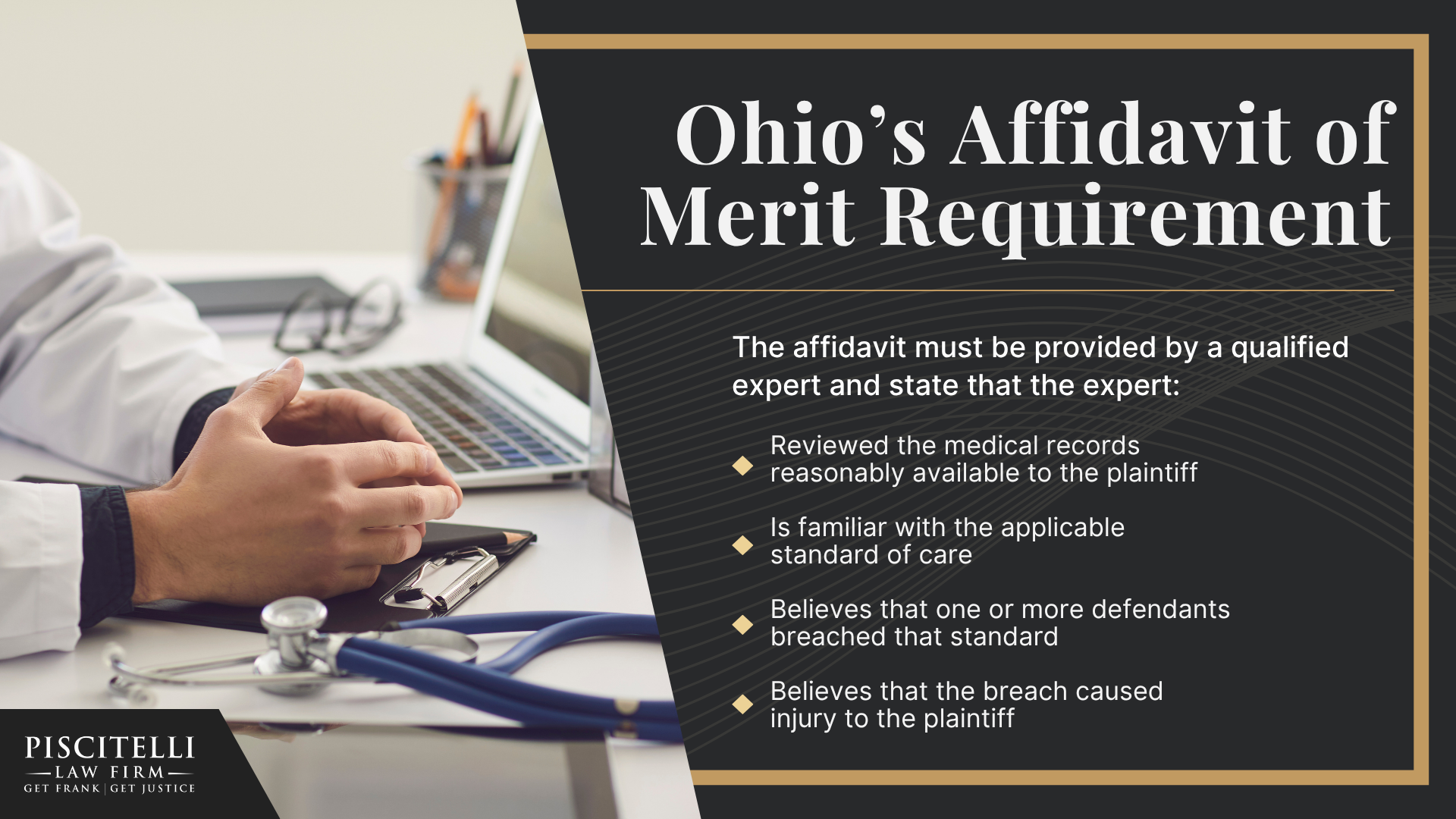
Ohio Civil Rule 10(D)(2) generally requires a medical-claim complaint to be accompanied by one or more affidavits of merit for each named defendant whose liability requires expert testimony.
The affidavit must be provided by a qualified expert and state that the expert:
Reviewed the medical records reasonably available to the plaintiff
Is familiar with the applicable standard of care
Believes that one or more defendants breached that standard
Believes that the breach caused injury to the plaintiff
When the plaintiff cannot obtain the affidavit before filing, a motion requesting additional time must be filed with the complaint.
For good cause, the court may grant a reasonable period of up to 90 days, with additional time possible under the circumstances identified in the rule.
The affidavit establishes the adequacy of the complaint.
It does not replace the expert testimony and evidence required to prove the case, and the affidavit is not otherwise admissible as trial evidence.
Medical malpractice can arise in hospitals, emergency departments, surgical centers, clinics, pharmacies, nursing facilities, and physician offices throughout Ohio.
Healthcare professionals may be responsible when negligent diagnosis, treatment, monitoring, surgery, medication management, or follow-up care causes preventable harm.
Injury victims can suffer consequences ranging from additional treatment and extended recovery to permanent disability, severe brain damage, or death.
Some cases involve a single medical provider, while others require investigation of multiple physicians, nurses, hospitals, or other healthcare professionals who participated in the patient’s care.
Birth injuries can be especially serious when alleged negligence during pregnancy, labor, delivery, or newborn care results in neurological injury or other permanent impairment.
Conditions such as cerebral palsy do not automatically establish malpractice, because medical experts must determine whether negligent care caused or contributed to the child’s injury.
An experienced medical malpractice attorney can review the treatment history, identify the providers involved, and work with qualified experts to evaluate whether the evidence supports a claim.
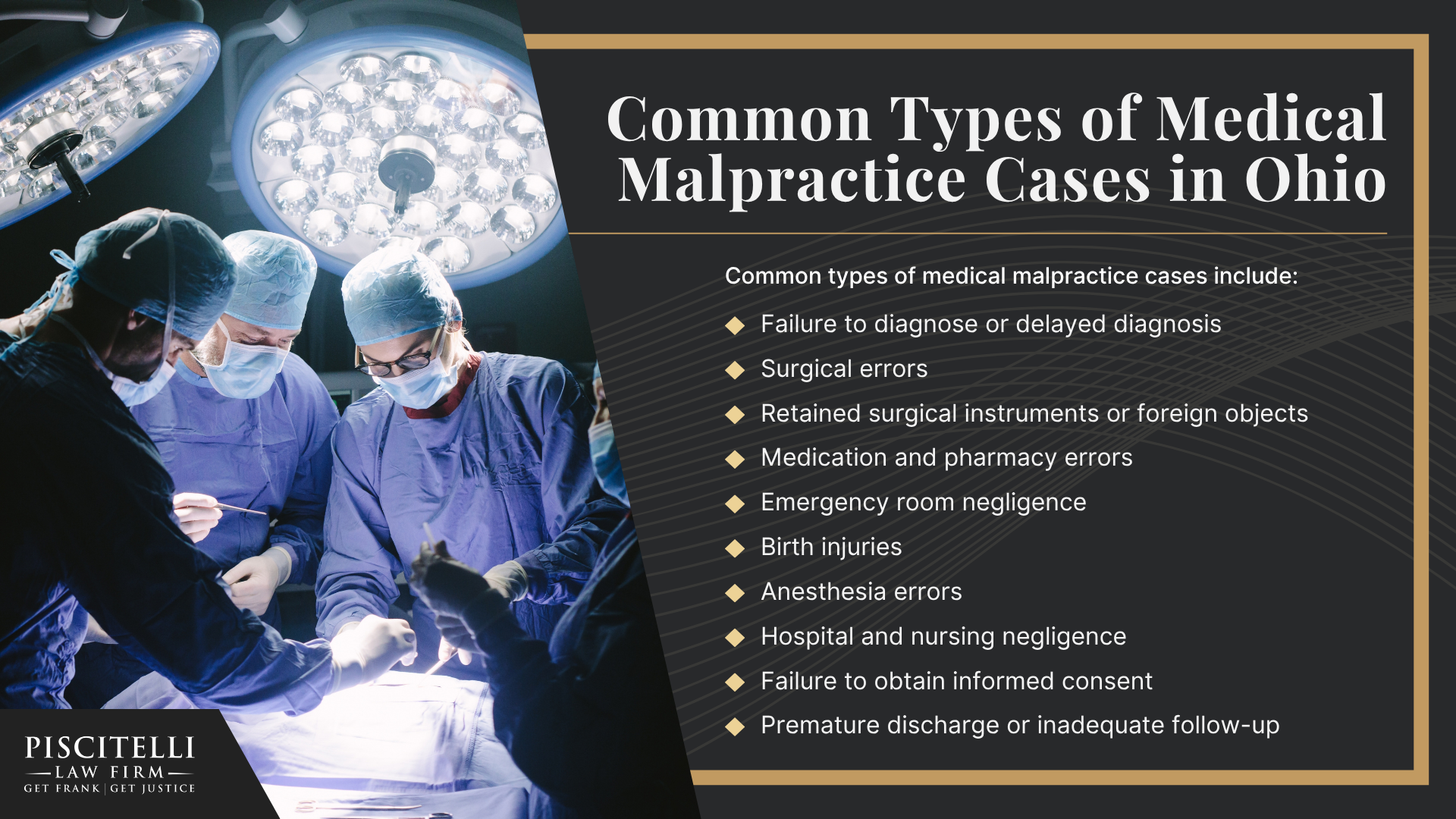
Common types of medical malpractice cases include:
Failure to diagnose or delayed diagnosis: Claims may arise when a provider fails to identify cancer, stroke, heart attack, infection, sepsis, blood clots, internal bleeding, or another serious condition in a timely manner.
Surgical errors: Negligence may involve operating on the wrong body part, performing the wrong procedure, damaging organs or nerves, failing to control bleeding, or making other preventable mistakes during surgery.
Retained surgical instruments or foreign objects: Leaving surgical instruments, sponges, or other objects inside a patient after a procedure can cause infection, internal injury, additional surgery, and other serious complications.
Medication and pharmacy errors: Claims may involve prescribing or administering the wrong drug or dose, failing to identify allergies or dangerous interactions, or providing incorrect medication instructions.
Emergency room negligence: Delayed treatment, inadequate testing, poor triage, missed warning signs, or premature discharge can allow a serious condition to worsen.
Birth injuries: Claims may involve delayed cesarean delivery, failure to respond to fetal distress, improper use of forceps or vacuum extraction, inadequate monitoring, or delayed treatment of a newborn condition.
Anesthesia errors: Improper dosing, inadequate monitoring, failure to recognize airway problems, medication interactions, or delayed response to complications can cause catastrophic injury.
Hospital and nursing negligence: Medical staff may fail to monitor a patient, report significant changes, follow treatment orders, prevent falls or pressure injuries, or respond appropriately to signs of deterioration.
Failure to obtain informed consent: A claim may arise when a provider does not disclose legally required information about material risks, alternatives, or the nature of a proposed procedure before obtaining the patient’s consent.
Premature discharge or inadequate follow-up: Sending a patient home before the condition is medically stable or failing to arrange necessary follow-up care can contribute to additional injury.
Each type of malpractice claim requires evidence showing that the provider’s conduct fell below the applicable standard of care and caused additional harm.
The diagnosis or complication alone is not enough to establish negligence, particularly in complex cases involving severe brain damage, cerebral palsy, or other conditions with multiple possible causes.
Medical records and qualified expert review are usually necessary to determine whether the treatment provided by the healthcare professionals involved supports a malpractice claim.
Who Can Be Held Liable in an Ohio Medical Malpractice Case?
Liability in an Ohio medical malpractice case depends on who provided the relevant care, whose conduct departed from the applicable standard of care, and whether that conduct caused the patient’s injury.
Ohio Revised Code § 2305.113 defines a “medical claim” to include claims arising from medical diagnosis, care, or treatment against physicians, hospitals, certain residential facilities, nurses, physician assistants, physical therapists, and employees or agents of covered medical providers or facilities.
A case may involve one defendant or several providers whose separate acts or omissions contributed to the patient’s harm.
Hospitals and medical organizations may also face claims based on their own conduct or, in appropriate circumstances, the conduct of healthcare professionals acting as their employees or agents.
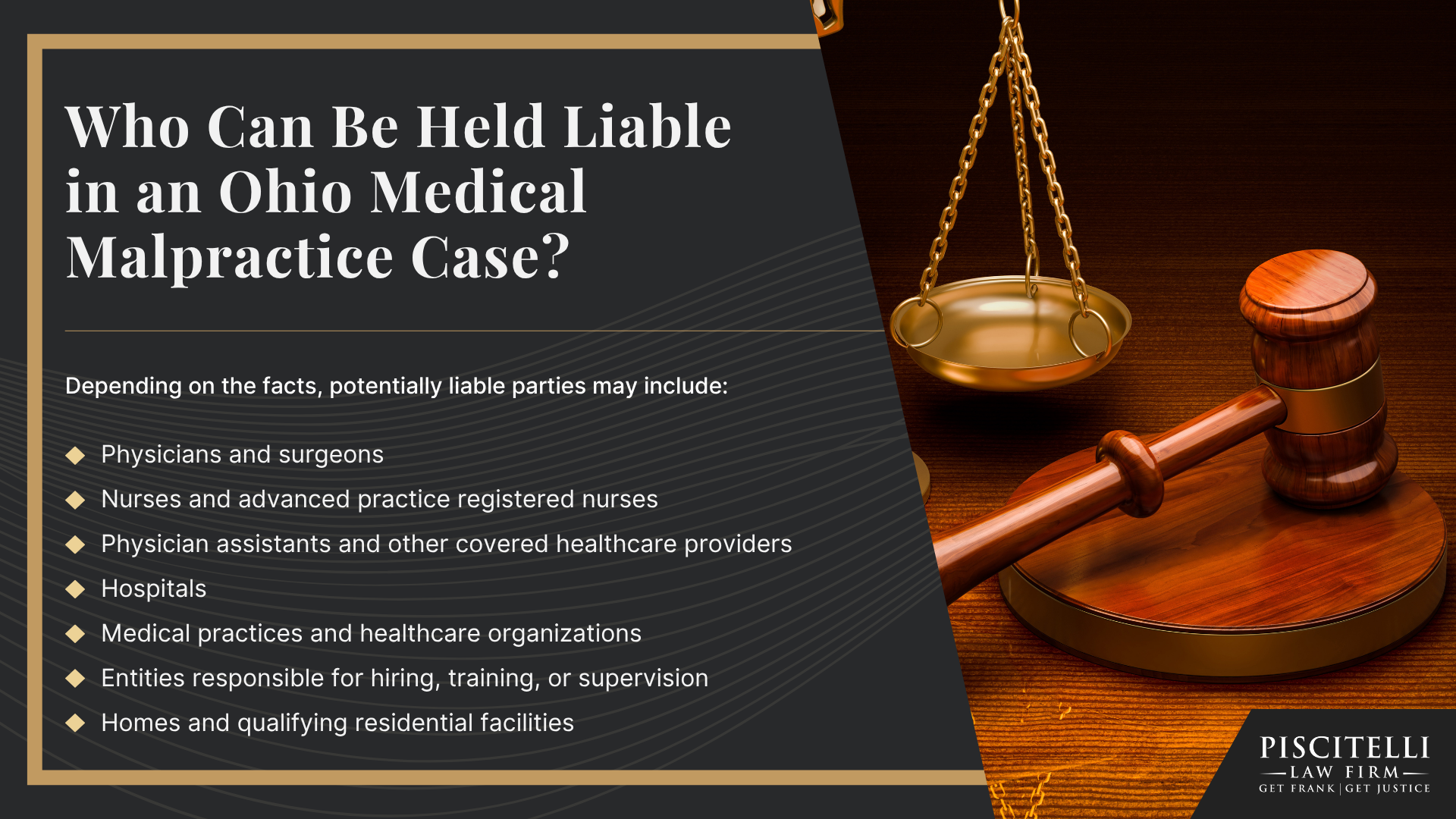
Depending on the facts, potentially liable parties may include:
Physicians and surgeons: A doctor may be liable when negligent diagnosis, treatment, surgery, monitoring, or follow-up care causes additional injury.
Nurses and advanced practice registered nurses: Nursing negligence may involve medication administration, patient monitoring, communication of changes in condition, or failure to carry out appropriate treatment orders.
Physician assistants and other covered healthcare providers: Liability may arise when a provider’s own negligent medical care contributes to the patient’s injury.
Hospitals: A hospital may face liability for negligent institutional practices, nursing care, or other conduct attributable to the hospital. Ohio also recognizes circumstances in which a hospital may be held liable under agency principles for negligence by an independent medical practitioner.
Medical practices and healthcare organizations: A practice or other medical entity may be responsible for negligent acts of employees or agents when Ohio law supports vicarious liability.
Entities responsible for hiring, training, or supervision: Ohio’s medical-claim statute expressly includes certain claims arising from the hiring, training, supervision, retention, or termination of caregivers who provide medical diagnosis, care, or treatment.
Homes and qualifying residential facilities: Ohio law also includes certain claims against homes and residential facilities when the alleged injury arises from medical diagnosis, treatment, skilled nursing care, or care provided under a resident’s plan of care.
A hospital is not automatically responsible for every physician who treats a patient within its facility, so the employment, agency, and contractual relationships between the parties may require close review.
The medical records, provider roles, institutional policies, and circumstances surrounding the treatment can help determine which individuals or entities should be included in a claim.
How is Medical Malpractice Proven?
To prove medical malpractice in Ohio, an injured patient generally must establish four key elements: duty, breach of the applicable standard of care, causation, and damages.
The patient must first show that a doctor patient relationship or another legally recognized provider-patient relationship existed and that the health care provider failed to provide care consistent with the applicable medical standard.
Negligent treatment must then be shown to have directly caused or worsened the patient’s injury, rather than merely coinciding with a poor medical outcome.
Expert testimony is often required to establish what the standard of care required, how the provider departed from that standard, and whether the departure caused the patient’s harm.
A medical malpractice claim may require evidence such as:
Proof of a doctor patient relationship or other provider-patient relationship
Complete medical records showing the diagnosis, treatment, and course of care
Expert testimony establishing the applicable standard of care
Evidence showing how the health care provider failed to meet that standard
Expert medical opinions connecting the negligent treatment to the patient’s injury
Medical bills and records of additional treatment caused by the injury
Employment and financial records documenting lost income or reduced earning capacity
Evidence of future medical expenses and long-term care needs
Documentation supporting non economic damages such as pain and suffering, disability, disfigurement, or loss of enjoyment of life
Ohio medical malpractice complaints also generally require an affidavit of merit when expert testimony is necessary to establish liability.
The affidavit does not prove the entire case, but it requires a qualified medical expert to review the reasonably available records and provide an opinion that the applicable standard of care was breached and that the breach caused injury.
You may qualify for a medical malpractice lawsuit if a healthcare provider departed from the applicable standard of care and that failure caused additional injury or worsened your condition.
A medical malpractice lawyer represents patients injured by healthcare negligence and can review the medical records, treatment history, and circumstances surrounding the alleged error.
Claims may involve physicians, nurses, hospitals, specialists, or multiple parties within the medical profession depending on who participated in the patient’s care.
Expert witnesses are often needed to explain the applicable standard of care, identify the alleged breach, and connect that breach to the patient’s injuries.
Recoverable losses may include additional medical expenses, lost income, physical pain, disability, and mental anguish when supported by the evidence.
Many attorneys evaluate whether the facts support a viable claim before filing because a poor outcome alone does not establish malpractice.
If a claim is supported, medical malpractice lawyers can guide the case through settlement negotiations or litigation.
Frank Piscitelli can review the available evidence and explain whether the facts may support a medical malpractice lawsuit under Ohio law.
Evidence That Can Help Support a Medical Malpractice Claim
A strong medical malpractice claim depends on evidence.
The more complete the record, the easier it may be to determine whether a provider made a medical mistake and whether that mistake caused harm.
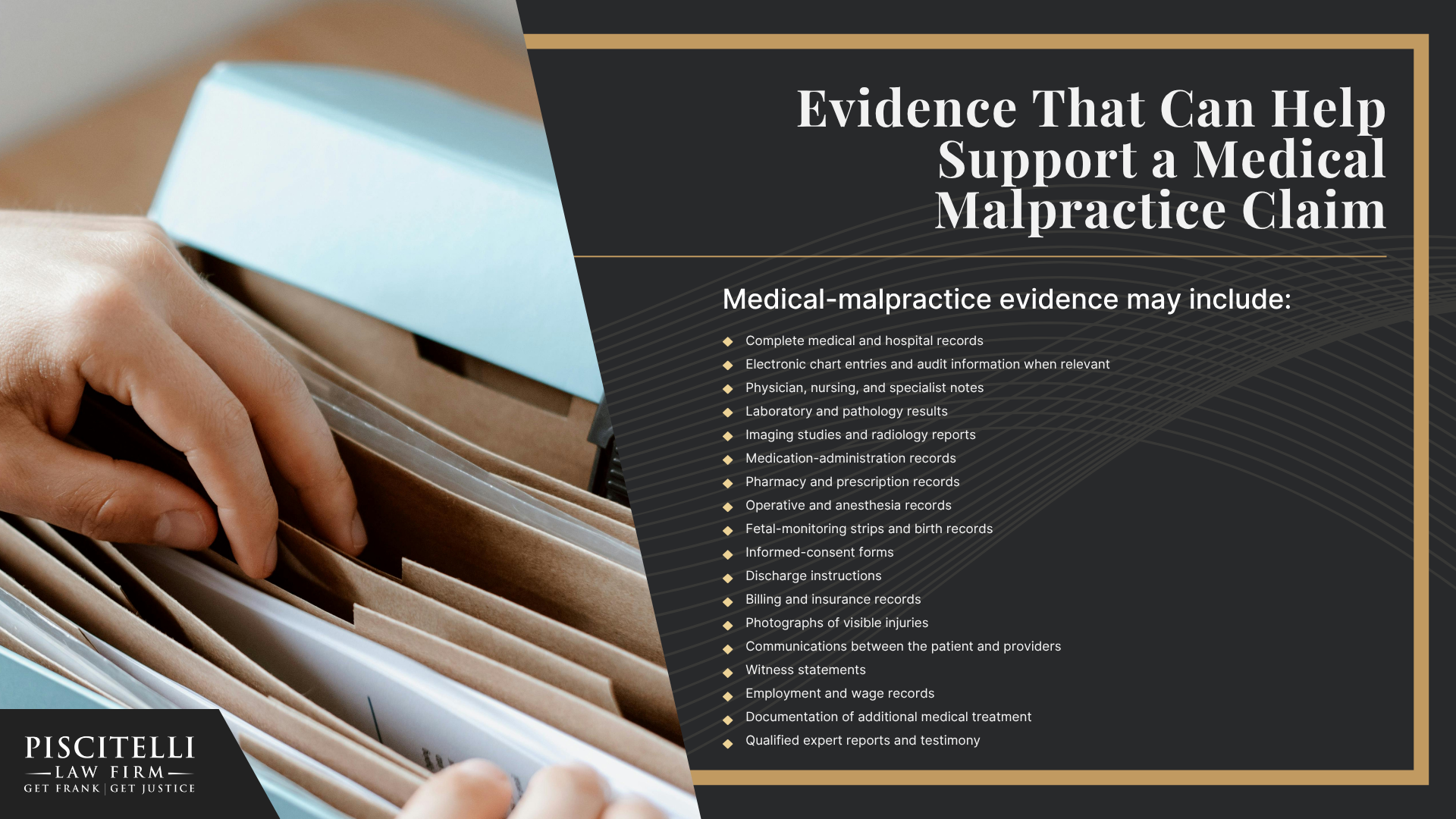
Medical-malpractice evidence may include:
Complete medical and hospital records
Electronic chart entries and audit information when relevant
Physician, nursing, and specialist notes
Laboratory and pathology results
Imaging studies and radiology reports
Medication-administration records
Pharmacy and prescription records
Operative and anesthesia records
Fetal-monitoring strips and birth records
Informed-consent forms
Discharge instructions
Billing and insurance records
Photographs of visible injuries
Communications between the patient and providers
Witness statements
Employment and wage records
Documentation of additional medical treatment
Qualified expert reports and testimony
A medical malpractice law firm can gather evidence, consult qualified experts, and build a case designed to hold medical professionals accountable.
What Compensation Is Available in a Mentor Medical Malpractice Case?
Compensation depends on the injuries, medical evidence, financial losses, applicable defenses, and Ohio law.
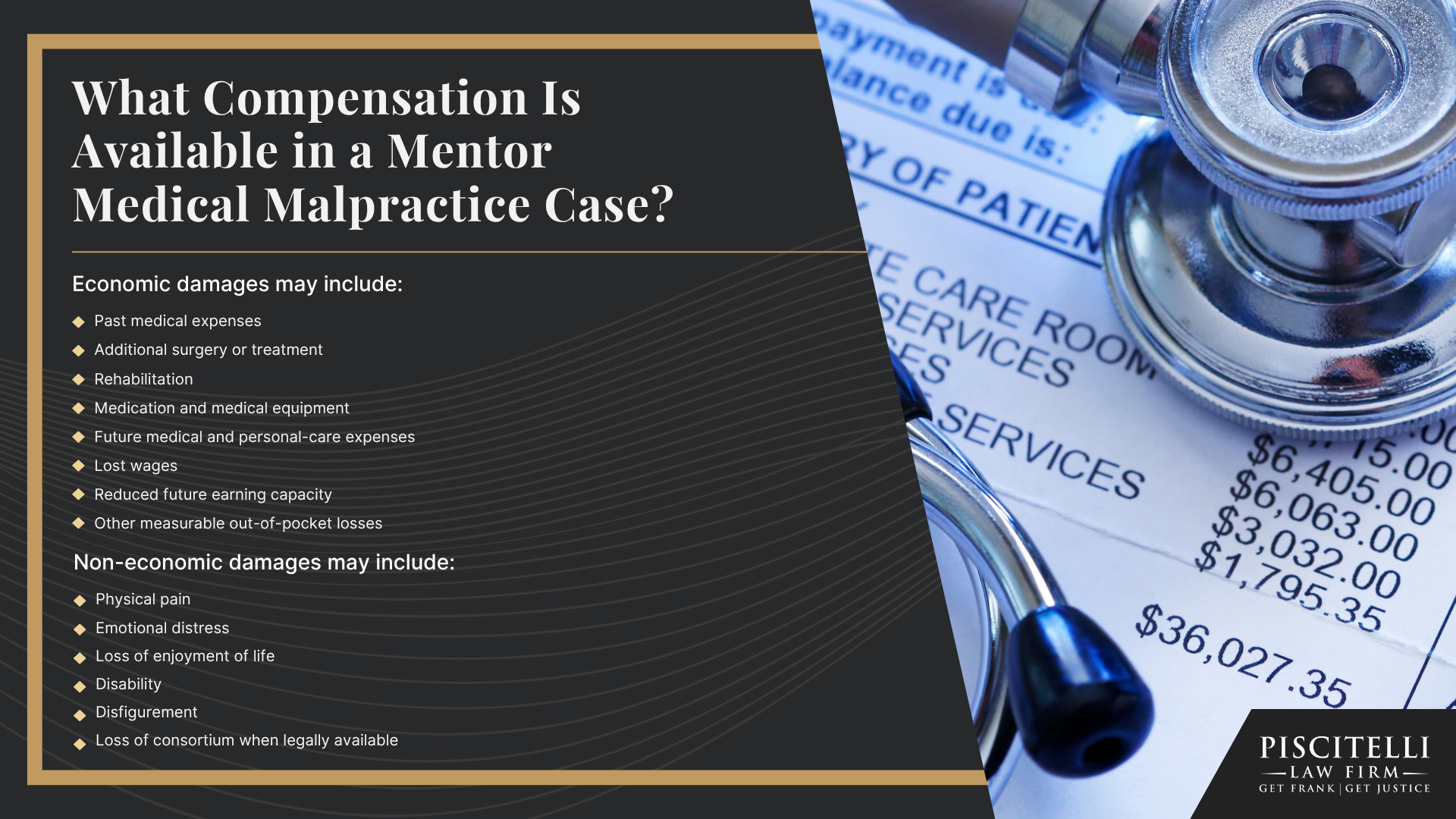
Economic damages may include:
Past medical expenses
Additional surgery or treatment
Rehabilitation
Medication and medical equipment
Future medical and personal-care expenses
Lost wages
Reduced future earning capacity
Other measurable out-of-pocket losses
Ohio Revised Code Section 2323.43 does not impose a statutory cap on compensatory damages representing proven economic loss in a medical claim.
Noneconomic damages may include:
Physical pain
Emotional distress
Loss of enjoyment of life
Disability
Disfigurement
Loss of consortium when legally available
Under Ohio Revised Code § 2323.43, noneconomic damages in a medical claim are generally limited to the greater of $250,000 or three times the plaintiff’s economic loss, subject to a maximum of $350,000 per plaintiff and $500,000 per occurrence.
The statute provides higher limits of $500,000 per plaintiff and $1 million per occurrence when the plaintiff suffers a permanent and substantial physical deformity, loss of use of a limb or bodily organ system, or a qualifying permanent physical functional injury that prevents independent self-care and performance of life-sustaining activities.
If you believe medical negligence harmed you or a family member, it is important to act quickly.
Medical malpractice claims are time-sensitive, evidence can become harder to obtain, and Ohio law has strict deadlines.
If you suspect malpractice, consider these steps:
Seek medical attention if you need additional care
Request copies of your medical records
Write down what happened while details are fresh
Save prescriptions, discharge papers, test results, and billing records
Keep a list of doctors, nurses, hospitals, and other providers involved
Avoid arguing with providers or signing unnecessary documents
Do not give a recorded statement to an insurance company without legal advice
Contact a Mentor medical malpractice lawyer for a free consultation
You can also use Piscitelli Law Firm’s online contact form or the chat feature on this page to ask whether you may have a medical malpractice case.
How Long Do You Have To File a Medical Malpractice Lawsuit in Ohio?
Ohio Revised Code Section 2305.113 generally requires a medical, dental, optometric, or chiropractic claim to be filed within one year after the cause of action accrues.
Under Ohio law, determining when a medical malpractice claim accrues may require examining when the patient discovered, or reasonably should have discovered, the resulting injury and when the physician-patient relationship for the condition at issue ended.
The one-year period generally begins with the later of those events. A cognizable event that connects the patient’s injury to prior medical diagnosis, care, or treatment can trigger a duty to investigate a potential malpractice claim.
A claimant may obtain additional filing time against a prospective defendant by providing qualifying written notice before the one-year limitations period expires.
Under Ohio Revised Code § 2305.113(B), an action against the person who receives proper notice may be filed within 180 days after the notice is given.
The statute requires the notice to be sent by certified mail, return receipt requested, to an address permitted under the statute.
Ohio also generally prohibits medical claims filed more than four years after the act or omission that forms the basis of the claim.
This four-year statute of repose can bar a claim even when the patient did not discover the injury until later.
Ohio law provides limited exceptions to the four-year rule.
A patient who could not reasonably have discovered an injury within three years, but discovers it before the four-year period expires, may have one year from discovery to file.
A separate provision generally allows a claim involving a foreign object left in the patient’s body to be filed within one year after the object was discovered or reasonably should have been discovered.
Ohio law also addresses minority and unsound mind in connection with the statute of repose.
The one-year statute of limitations, 180-day notice provision, and four-year statute of repose are separate rules and should be evaluated independently.
Because the applicable deadline depends on the treatment history, discovery of the injury, provider-patient relationship, notice requirements, and any statutory exceptions, the filing period should be calculated from the facts of the individual case.
Piscitelli Law Firm: Talk to a Mentor Medical Malpractice Lawyer Today
Medical negligence can leave patients and families facing additional treatment, lost income, long-term care needs, and a substantial financial burden.
Frank Piscitelli has more than 30 years of experience representing injured Ohioans and evaluating serious personal injury and medical malpractice claims.
His extensive experience allows him to investigate the medical care involved, review the available evidence, work with qualified experts, and determine whether the facts support a claim against a healthcare provider or medical facility.
As an experienced attorney, Frank can pursue a resolution through settlement negotiations or litigation and seek to recover compensation for medical expenses, lost income, pain and suffering, and other losses supported by the evidence.
Piscitelli Law Firm offers free consultations to patients and families who believe medical negligence may have caused serious injury or death.
If you or a loved one was harmed by suspected medical malpractice in Mentor or elsewhere in Northeast Ohio, contact Piscitelli Law Firm today for a free consultation.
You can also use the chat feature on this page to contact Frank Piscitelli about your potential claim.
Proving a doctor’s negligence usually requires more than showing that treatment produced a poor outcome.
Medical records and qualified expert testimony may be needed to establish what the applicable standard of care required, how the provider departed from that standard, and whether the departure caused additional harm.
Relevant evidence may include:
Complete hospital and physician records
Laboratory and imaging results
Operative and anesthesia records
Medication records
Nursing notes and monitoring records
Communications between the patient and medical providers
Records of subsequent treatment required because of the injury
Testimony from qualified medical experts
The evidence must connect the alleged negligent treatment to the injury claimed by the patient.
A wrongful death claim may be available when medical negligence causes a patient’s death.
In Ohio, the action is generally brought by the deceased person’s personal representative for the benefit of qualifying family members rather than being filed individually by each relative.
Recoverable wrongful-death damages may include:
Funeral and burial expenses
Loss of financial support
Loss of services
Loss of companionship, care, and guidance
Loss of prospective inheritance
Mental anguish suffered by qualifying family members
Medical-malpractice wrongful-death cases can involve both Ohio’s wrongful-death laws and rules governing medical claims, including filing deadlines that should be evaluated from the specific facts.
Medical malpractice cases are subject to strict procedural deadlines, including Ohio’s general one-year statute of limitations and four-year statute of repose.
A lawyer can determine when the claim may have accrued, evaluate whether the 180-day notice provision or another statutory rule applies, and prepare the required filings before the applicable deadline.
Legal counsel may also coordinate the medical-record review and affidavit-of-merit process required in many malpractice cases.
Lawyers help keep malpractice cases in compliance with procedural requirements while preserving the patient’s ability to pursue the claim through settlement negotiations or litigation.
Verdicts and settlements can provide information about an attorney’s experience handling serious injury claims, but past results do not predict what will happen in a new case.
Medical malpractice cases depend on the specific treatment involved, available expert testimony, causation evidence, damages, and applicable defenses.
When evaluating an attorney, consider factors such as:
Experience with medical malpractice litigation
Ability to work with qualified medical experts
Experience preparing cases for trial
Familiarity with Ohio medical-claim requirements
Resources available to investigate complex medical evidence
Relevant verdicts and settlements
Willingness to take a case to court when necessary
Experienced trial lawyers prepare claims with litigation in mind even when a negotiated resolution remains possible.
There is no objective list of the best lawyers for every medical malpractice case because the right attorney depends on the facts, medical issues, and type of injury involved.
Patients should look beyond advertising claims and consider an attorney’s relevant experience, approach to medical evidence, familiarity with Ohio malpractice law, and ability to prepare a case for trial.
A consultation also gives you an opportunity to ask how the attorney evaluates potential malpractice, works with medical experts, handles litigation costs, and communicates with clients.
Frank Piscitelli has more than 30 years of experience representing injured Ohioans and can review the circumstances of a potential medical malpractice claim during a free consultation.
Member of the Ohio State Bar Association since 1993. With 30+ years of legal experience, Attorney Frank Piscitelli has secured over $55 million in compensation for Ohio injury victims, car accident victims, and surviving family members of Ohio wrongful death victims.
Legally Reviewed
This article has been written and reviewed for legal accuracy and clarity by the team of writers and attorneys at Piscitelli Law Firm and is as accurate as possible. This content should not be taken as legal advice from an attorney. If you would like to learn more about our owner and experienced Ohio personal injury lawyer, Frank Piscitelli, you can do so here.
Fact-Checked
Piscitelli Law Firm does everything possible to make sure the information in this article is up to date and accurate. If you need specific legal advice about your case, contact us. This article should not be taken as advice from an attorney.