Frank Piscitelli Handles Serious Auto Accident Cases In Cleveland
A Cleveland Auto Accident Lawyer at Piscitelli Law Firm represents injured drivers, passengers, and families after serious crashes in Cleveland and throughout Cuyahoga County.
We help accident victims pursue financial recovery when another driver or responsible party causes harm through negligence, reckless driving, or violations of traffic laws.
Our firm handles a wide range of auto accident cases, including rear-end collisions, intersection and T-bone crashes, left-turn impacts, multi-vehicle pileups, hit-and-run wrecks, and crashes involving distracted or impaired driving.
We also represent clients in claims involving uninsured or underinsured motorists and other situations where insurance coverage disputes affect recovery.
Piscitelli Law Firm is actively handling Cleveland auto accident claims for individuals injured through no fault of their own and seeking accountability under Ohio law.
Were You Injured in an Cleveland Auto Accident Through No Fault of Your Own? Contact Us
A serious car crash can leave you facing mounting medical expenses, missed paychecks, and long-term disruptions to your daily life, especially when injuries require surgery, rehabilitation, or ongoing treatment.
In the days after the collision, the insurance company may contact you quickly with questions, requests for a recorded statement, or an early offer that does not reflect the full scope of your injuries and future needs.
Piscitelli Law Firm steps in to manage those communications, gather evidence, and protect your claim while you focus on medical care and recovery.
A Cleveland auto accident lawyer investigates how the crash happened, identifies all potentially responsible parties, and preserves key proof such as police reports, witness statements, scene photos, vehicle damage documentation, and any available video before it disappears.
Your auto accident lawyer Cleveland evaluates the full value of your losses, including future medical needs and reduced earning capacity, then advises you on whether a settlement is realistic or whether litigation is necessary.
Throughout the process, a car accident lawyer Cleveland keeps the case prepared for court and focused on liability and damages, which matters when insurers try to shift blame or minimize injuries.
If you or a loved one suffered serious injuries in a Cleveland crash caused by someone else’s negligence, you may be eligible to file a claim and pursue compensation under Ohio law.
Contact Piscitelli Law Firm for a free consultation with a Cleveland car accident lawyer, or use the chat feature on this page to connect with our legal team.
A Cleveland auto accident lawyer helps an injured person protect their rights against the insurance company, develop the evidence needed for a personal injury claim, and pursue fair compensation supported by the facts.
Most Cleveland car accident lawyers move quickly to gather critical proof such as police reports, medical records, witness statements, and any available surveillance footage before it disappears.
Ohio also applies modified comparative fault, so early evidence can matter when insurers try to shift blame to reduce what they pay.
A Cleveland law firm can also bring resources that many claims require, including accident reconstruction experts and medical testimony for serious injury cases.
Familiarity with the Cuyahoga County Court of Common Pleas can be a strategic advantage if negotiations fail and litigation becomes necessary.
Cleveland personal injury attorneys also prepare cases for trial when insurance companies refuse to offer fair settlements, which can change the leverage in negotiations.
Cost and ethics should be addressed clearly at the start.
Many car accident attorneys offer a free consultation, and many work on a contingency fee basis, meaning clients do not pay attorney fees unless a recovery is obtained.
In practice, contingency fees are often discussed in a range such as 33.3% to 40% of the final recovery, depending on the case posture and agreement.
It is also important to know that Ohio lawyers cannot make false, misleading, or non-verifiable communications about their services, which is why an attorney should not promise a specific settlement amount.
After a car accident, Ohio law requires drivers to stop and remain at the scene and exchange identifying and vehicle information with the other motorist and any police officer who arrives.
If anyone is injured or you suspect a serious crash, call 911 and request medical help and police response.
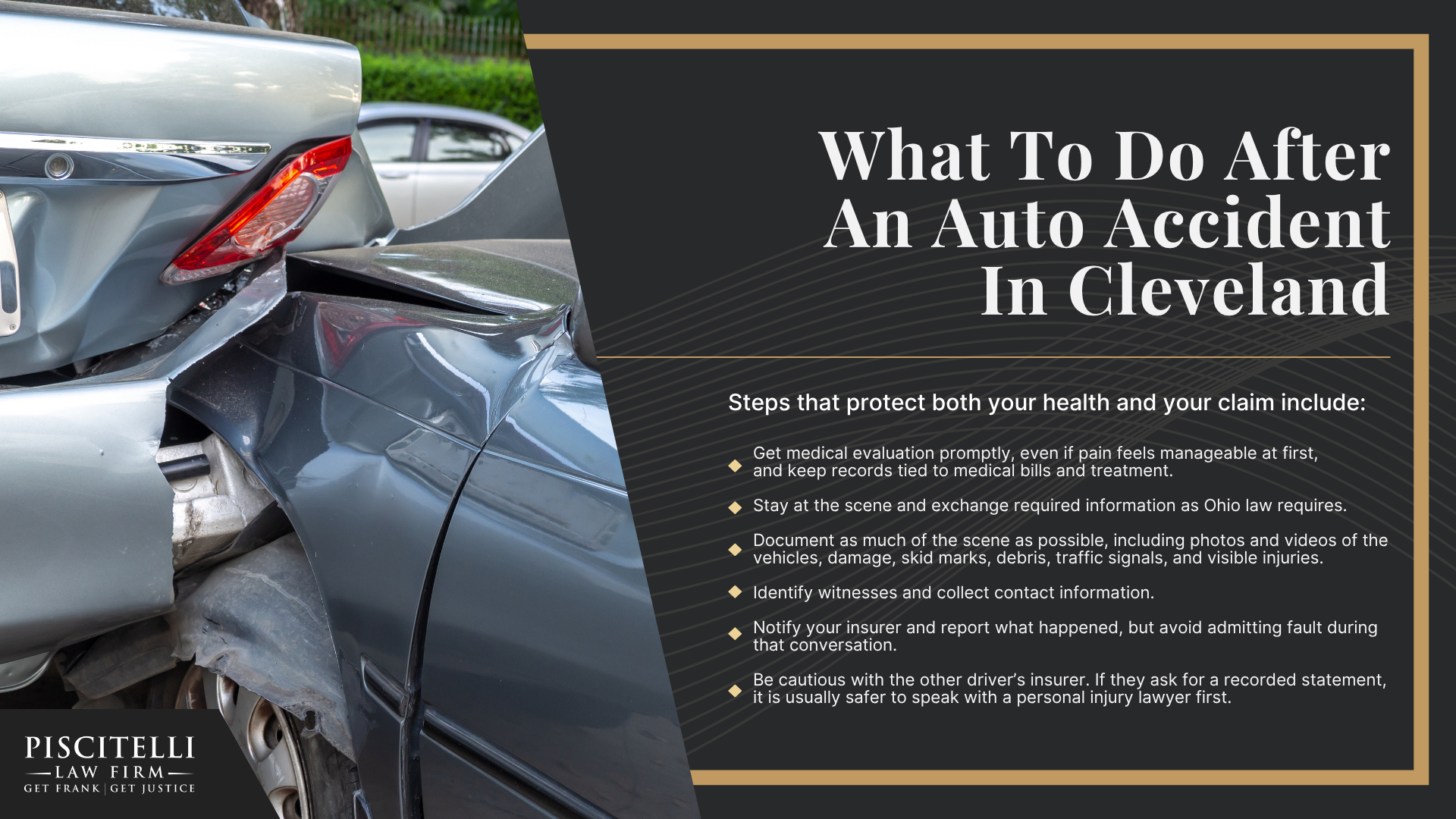
Steps that protect both your health and your claim include:
Get medical evaluation promptly, even if pain feels manageable at first, and keep records tied to medical bills and treatment.
Stay at the scene and exchange required information as Ohio law requires.
Document as much of the scene as possible, including photos and videos of the vehicles, damage, skid marks, debris, traffic signals, and visible injuries.
Identify witnesses and collect contact information.
Notify your insurer and report what happened, but avoid admitting fault during that conversation.
Be cautious with the other driver’s insurer. If they ask for a recorded statement, it is usually safer to speak with a personal injury lawyer first.
Ohio does not send law enforcement to every minor crash, and reporting rules can depend on the circumstances, so if police do not respond, ask your insurer or an accident lawyer what reporting steps may still apply in your situation.
Common Causes of Auto Accidents in Cleveland
Motor vehicle crashes are common across Ohio, and Cleveland sees a high concentration of personal injury events, including car accidents.
County-level crash reporting has cited that Cuyahoga County had 79 traffic fatalities in 2019, underscoring the seriousness of roadway risk in the area.
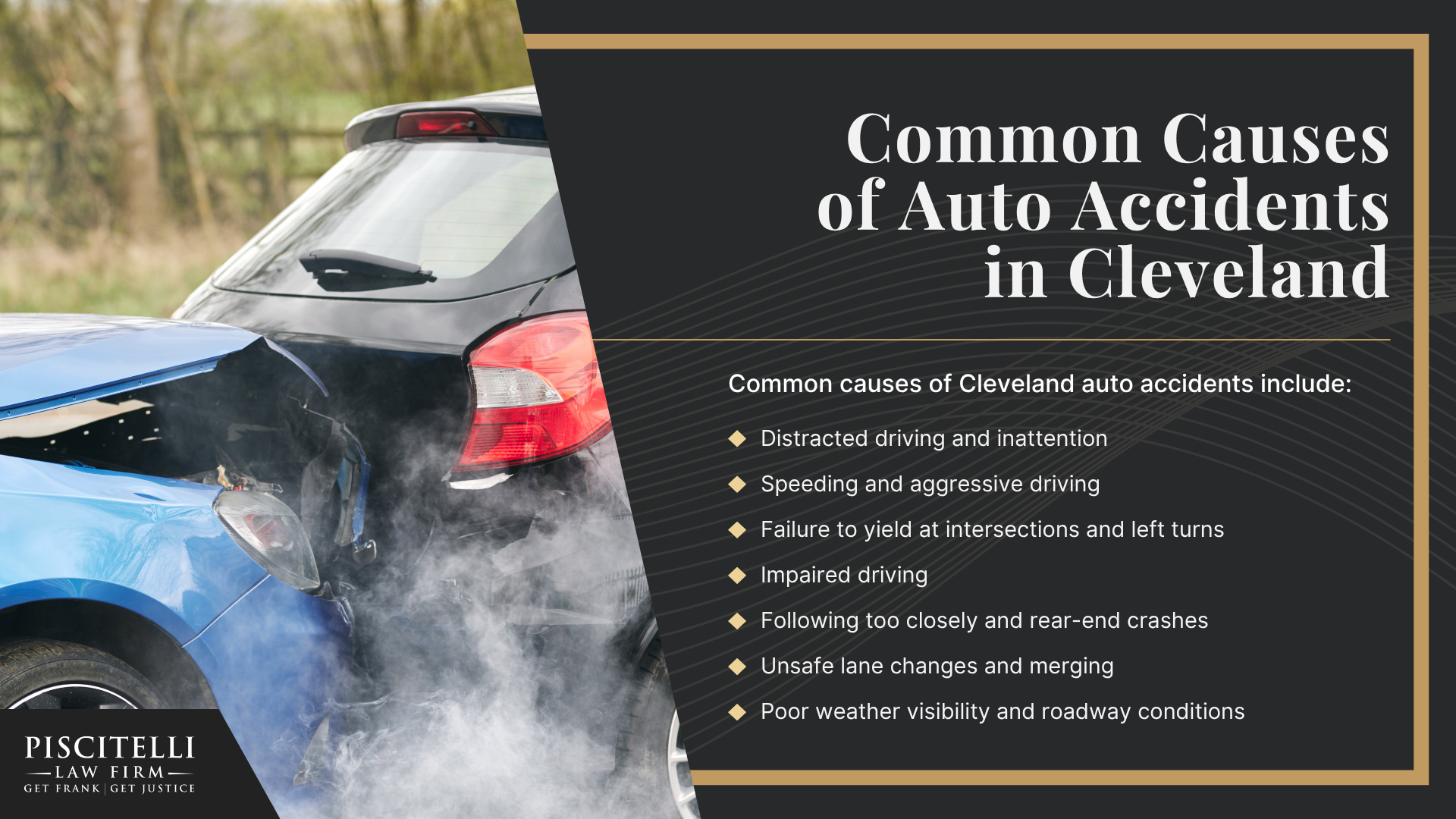
Common causes of Cleveland auto accidents include:
Distracted driving and inattention
Speeding and aggressive driving
Failure to yield at intersections and left turns
Impaired driving
Following too closely and rear-end crashes
Unsafe lane changes and merging
Poor weather visibility and roadway conditions
Ohio is a comparative fault state.
A person’s recovery is generally reduced by their percentage of fault, and recovery is barred if the injured person’s fault is greater than the combined fault of the other parties.
Types of Auto Accidents We Handle
Auto accidents in Cleveland range from straightforward rear-end collisions to complex multi-vehicle crashes with disputed fault and competing insurance coverage positions.
The type of crash matters because it often determines what evidence is available, which traffic laws apply, and how an insurance company frames liability.
A Cleveland auto accident lawyer evaluates the crash pattern early so the investigation focuses on the issues that typically decide these cases, including right-of-way, visibility, speed, and driver conduct.
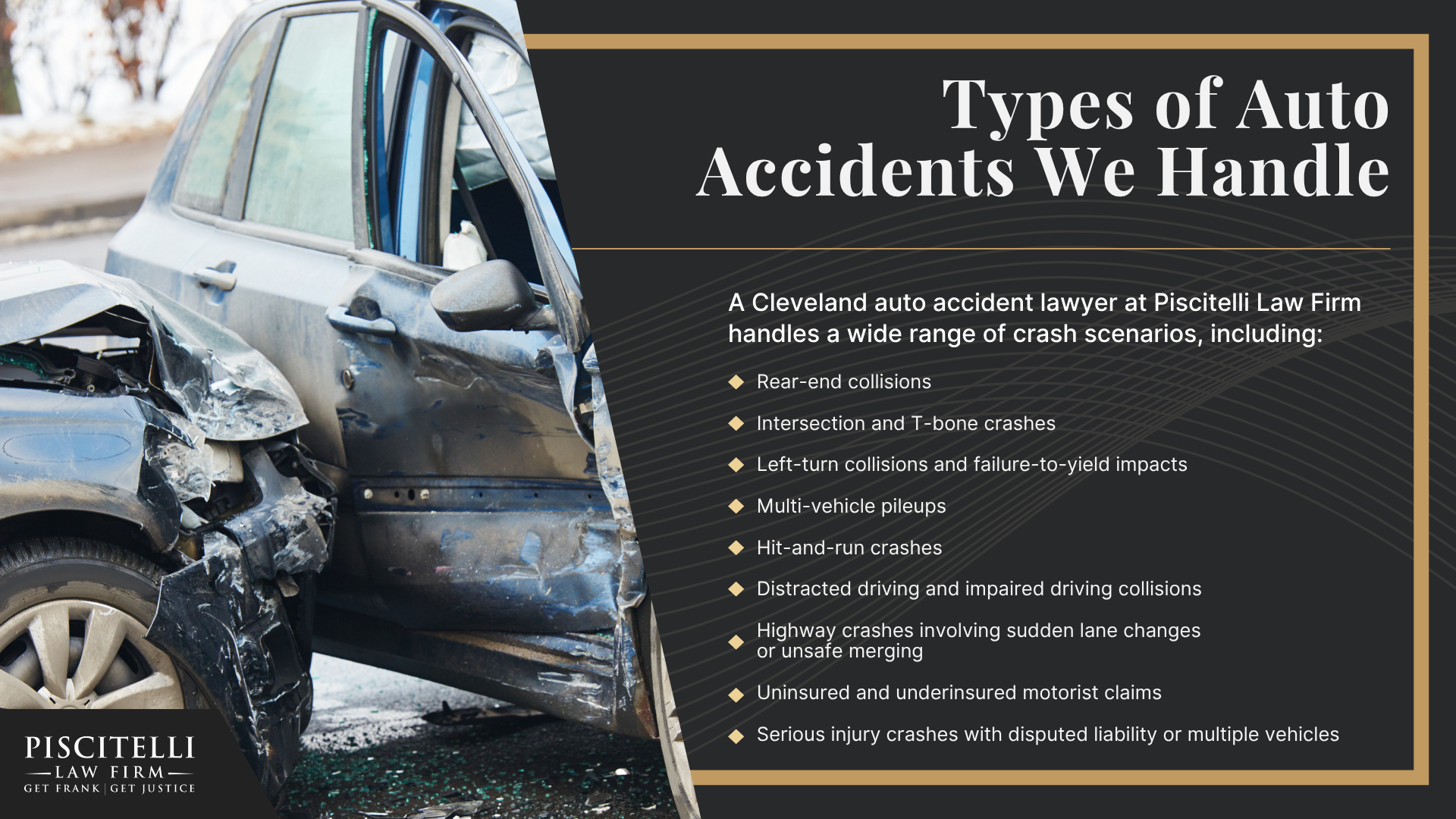
A Cleveland auto accident lawyer at Piscitelli Law Firm handles a wide range of crash scenarios, including:
Rear-end collisions
Intersection and T-bone crashes
Left-turn collisions and failure-to-yield impacts
Multi-vehicle pileups
Hit-and-run crashes
Distracted driving and impaired driving collisions
Highway crashes involving sudden lane changes or unsafe merging
Uninsured and underinsured motorist claims
Serious injury crashes with disputed liability or multiple vehicles
If a crash involves unique circumstances, such as a commercial vehicle, a rideshare, a government vehicle, or a roadway defect, those facts can change how a claim is investigated and which insurance policies apply.
Injuries Common in Cleveland Auto Accidents
Injury patterns after a car accident are not always obvious in the first few hours, and symptoms can evolve as inflammation and soft-tissue damage develop.
Many injured people feel “shaken up” at the scene, then experience worsening pain, stiffness, headaches, or neurological symptoms later that day or over the next several days.
Prompt medical evaluation and consistent follow-up help protect your health and create a clear record linking the crash to the injuries and treatment.
Auto accidents can cause injuries that are not fully obvious at the scene, especially when adrenaline masks symptoms.
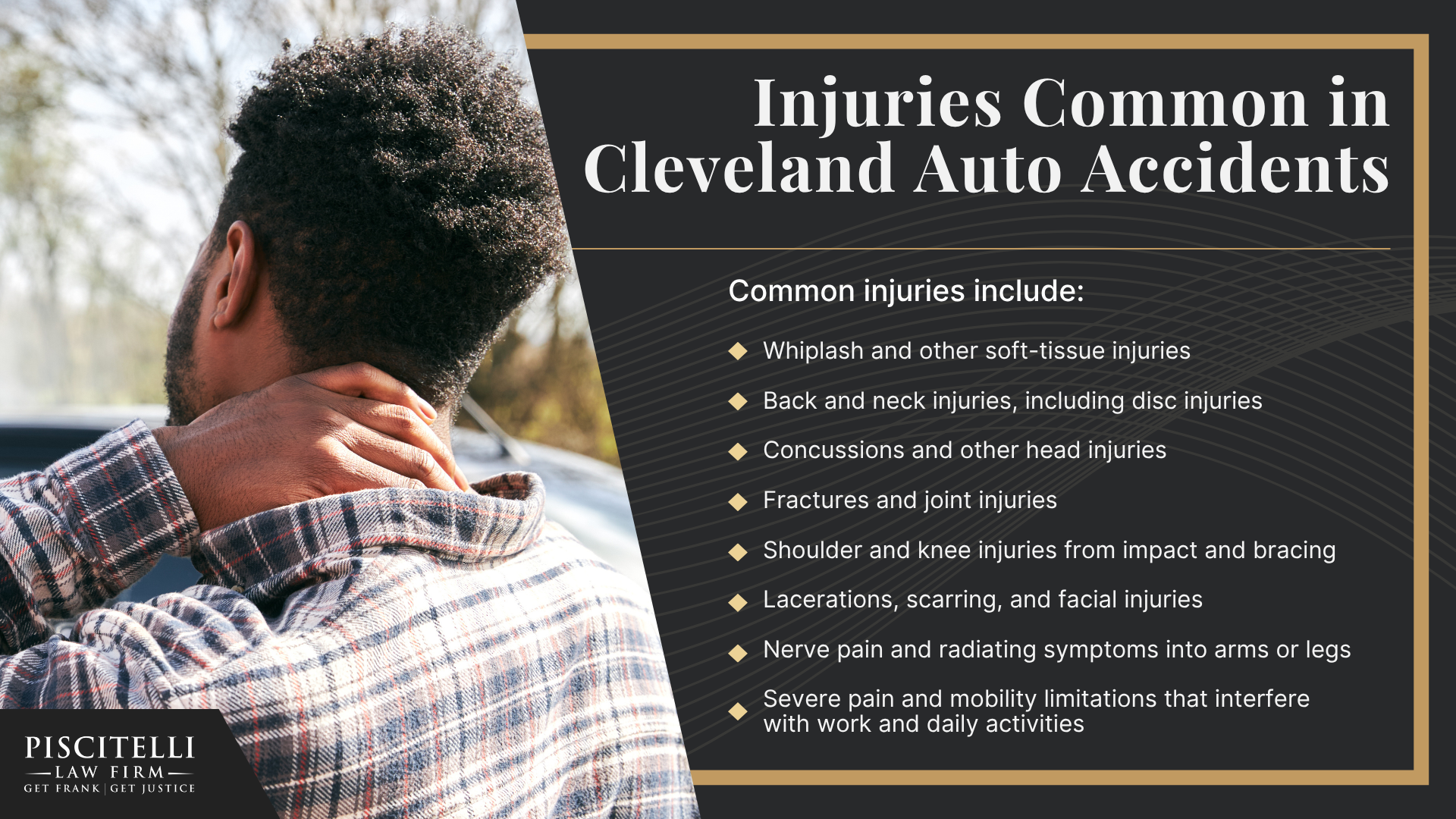
Common injuries include:
Whiplash and other soft-tissue injuries
Back and neck injuries, including disc injuries
Concussions and other head injuries
Fractures and joint injuries
Shoulder and knee injuries from impact and bracing
Lacerations, scarring, and facial injuries
Nerve pain and radiating symptoms into arms or legs
Severe pain and mobility limitations that interfere with work and daily activities
Because treatment often evolves over time, documentation matters.
Consistent medical attention, follow-up care, and clear reporting of symptoms help connect the crash to the injury and clarify why treatment was necessary.
Who May Be Liable For an Auto Accident In Cleveland?
Liability in a Cleveland-area car accident is not always limited to the at fault driver.
Depending on how the accident happened, more than one party may share responsibility, and identifying every liable party is often necessary to recover damages that fairly compensate injured people for medical care, lost income, and long-term limitations.
Experienced attorneys look beyond the initial crash narrative to determine whether someone failed to use reasonable care and whether that failure caused the injuries.
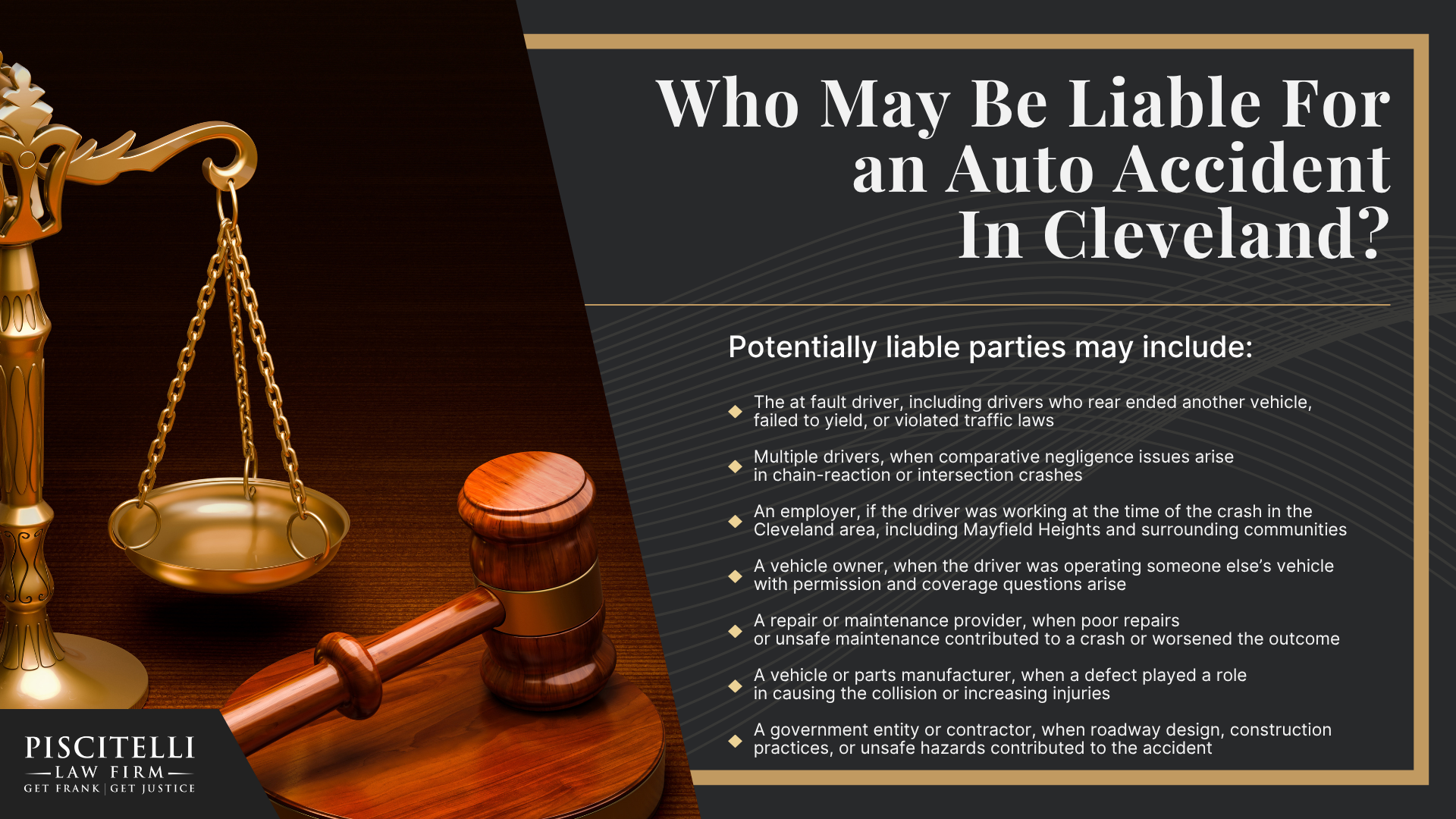
Potentially liable parties may include:
The at fault driver, including drivers who rear ended another vehicle, failed to yield, or violated traffic laws
Multiple drivers, when comparative negligence issues arise in chain-reaction or intersection crashes
An employer, if the driver was working at the time of the crash in the Cleveland area, including Mayfield Heights and surrounding communities
A vehicle owner, when the driver was operating someone else’s vehicle with permission and coverage questions arise
A repair or maintenance provider, when poor repairs or unsafe maintenance contributed to a crash or worsened the outcome
A vehicle or parts manufacturer, when a defect played a role in causing the collision or increasing injuries
A government entity or contractor, when roadway design, construction practices, or unsafe hazards contributed to the accident (these claims can involve different notice rules and deadlines)
A thorough liability analysis helps protect injured clients from the common insurance tactic of blaming the injured person to reduce what the claim is worth.
It also helps ensure the claim is positioned to account for the full impact on the injured person and their family members.
Understanding Ohio Auto Accident Laws and How They Impact a Claim
Ohio auto accident claims are driven by proof of fault and damages.
To succeed, an injured person generally must show that someone failed to use reasonable care, that the failure caused the accident, and that the injuries resulted in compensable losses.
That seems straightforward, but in practice, insurers often dispute how the accident happened, whether the injured person contributed to the crash, and whether the treatment was “necessary” or “related.”
Ohio follows a modified comparative negligence rule.
If the injured party is found partially at fault, their compensation may be reduced by their percentage of fault, and recovery is barred if the injured party’s fault is greater than the combined fault of the other parties.
This rule makes evidence collection and early case framing important, because insurers often argue that the injured person’s own actions contributed to the collision even when someone else’s negligence was the primary cause.
Ohio law also includes rules that shape how claims are valued, how damages are proven, and when a lawsuit must be filed.
Experienced attorneys with combined experience handling motor vehicle cases in the Cleveland area typically evaluate liability, damages, and litigation risk early, then guide clients through the entire process, from insurance claims through trial preparation if needed.
In more complex cases, expert witnesses may be used to explain crash dynamics, medical causation, future treatment needs, and long-term functional limitations.
What Compensation Can Cover in an Ohio Auto Accident Claims
Compensation in an Ohio auto accident claim is meant to address both the immediate impact of the crash and the future consequences of serious injuries.
Cleveland auto accident lawyers negotiate settlements to secure compensation that covers current needs and future needs, including ongoing treatment, reduced ability to work, and long-term limitations that affect daily life.
It is also crucial for injured individuals to avoid accepting the first settlement offer from an insurance company, because early offers are often lower than what injured people need once the full scope of treatment and recovery becomes clear.
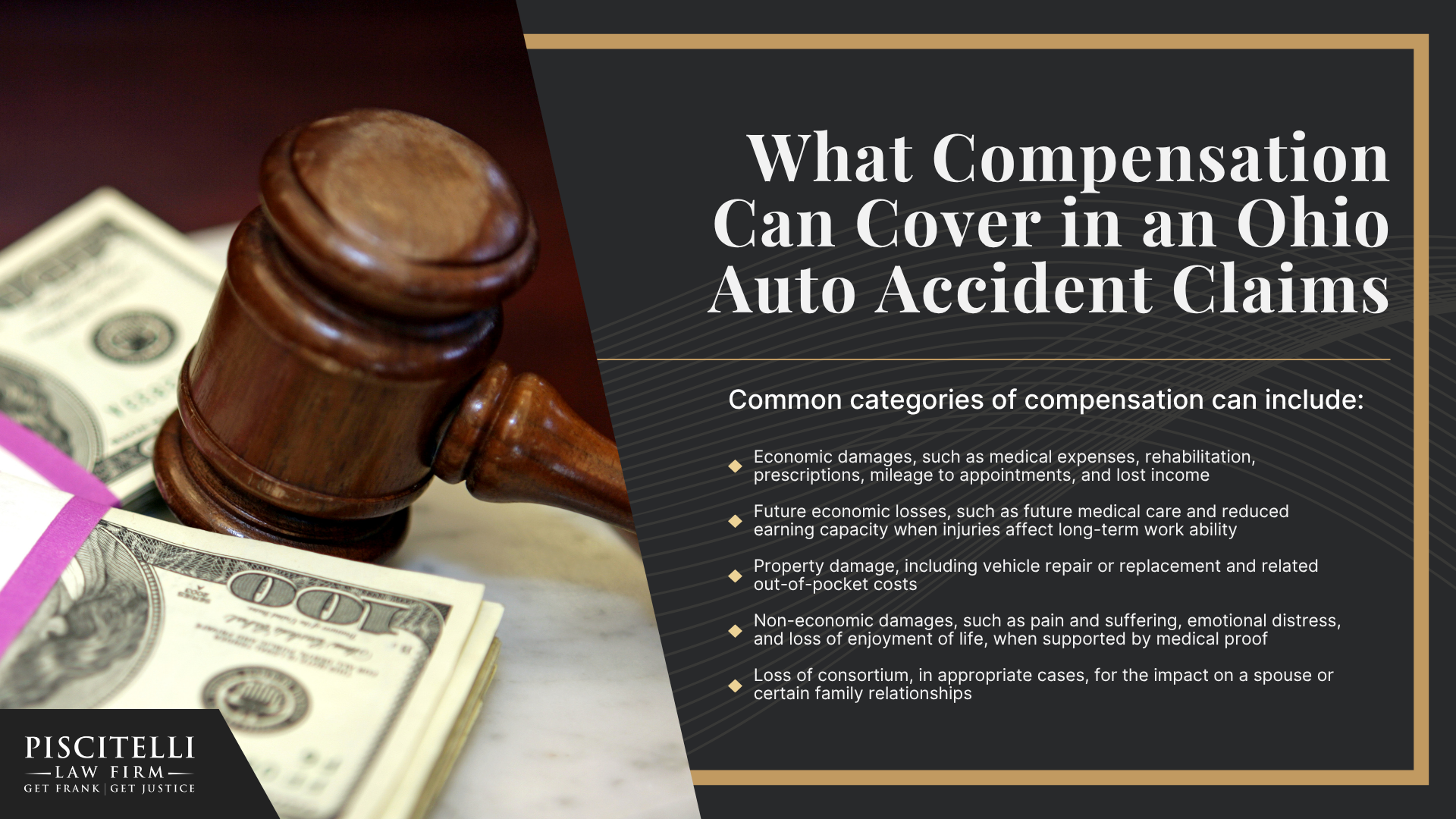
Common categories of compensation can include:
Economic damages, such as medical expenses, rehabilitation, prescriptions, mileage to appointments, and lost income
Future economic losses, such as future medical care and reduced earning capacity when injuries affect long-term work ability
Property damage, including vehicle repair or replacement and related out-of-pocket costs
Non-economic damages, such as pain and suffering, emotional distress, and loss of enjoyment of life, when supported by medical proof
Loss of consortium, in appropriate cases, for the impact on a spouse or certain family relationships
Ohio does not cap economic damages like medical expenses and lost wages, but it does cap certain non-economic damages such as pain and suffering in many cases, subject to exceptions and case-specific factors.
Ohio is also a comparative fault state, so compensation may be reduced if the injured party is assigned a percentage of fault under comparative negligence principles.
Because every accident is different, the value of a claim depends on the injuries, the strength of liability evidence, the consistency of medical documentation, and the long-term impact on the injured person and their loved one or family members.
The best interests of clients are usually served by building the claim carefully, documenting damages fully, and negotiating from a position supported by proof rather than pressure.
How Piscitelli Law Firm Builds Auto Accident Cases
Auto accident claims in Cleveland are built on proof, not pressure.
Piscitelli Law Firm starts by investigating the collision circumstances to determine how the crash happened, who was involved, and what evidence best shows negligence and fault.
That work typically includes obtaining police reports, photographing vehicle damage, interviewing witnesses, and preserving video when it exists, then organizing medical records and billing to prove the connection between the accident and the injuries.
Because personal injury claims in Cleveland can arise from many events, including car accidents and medical malpractice, the firm approaches each claim with a structured plan focused on liability and damages.
In Ohio, the motorist who causes an accident is responsible for the other party’s vehicle damages and medical treatments, so the case is built to show why the other driver’s negligence caused the harm and what recovery is supported by the file.
The firm also tracks deadlines, including the Ohio rule requiring most personal injury lawsuits to be filed within two years of the accident, and it accounts for comparative fault arguments, because compensation may be reduced if the injured person is found partly at fault.
When the injuries are severe or the facts are disputed, the firm can use qualified experts to strengthen proof and pursue the best possible outcome supported by the evidence.
Piscitelli Law Firm also develops damages carefully.
Personal injury claims often include economic damages such as medical expenses and lost income, and they may include other damages tied to pain, suffering, and how the injuries change a person’s life.
The goal is to help injured clients recover compensation that reflects the full impact of the collision, not just the first round of bills.
Why Insurance Companies Fight Cleveland Auto Accident Claims
Insurance companies fight claims because reducing payouts protects their bottom line.
They may argue the injured person was partly at fault, dispute whether treatment was necessary, challenge the seriousness of pain and limitations, or claim a medical issue existed before the crash.
They also look for gaps in documentation and may use recorded statements to shape the narrative in a way that reduces the value of the claim.
Personal injury attorneys assist by managing communications on your behalf, organizing proof, and pushing back when an insurer tries to underpay or unfairly deny a valid claim.
That can be especially important when the injured person is unable to work, faces mounting expenses, or is still in active treatment.
A lawyer’s job is to keep the claim focused on evidence, responsibility, and recovery while preparing the case for trial if the insurer refuses to offer a fair outcome.
Should You Accept a Settlement?
A settlement can provide faster financial relief, but it should match the evidence and the long-term realities of the injuries.
Accepting too early can create problems because once you settle, you usually cannot come back for additional recovery if new complications arise or if future treatment becomes necessary.
This is why the firm evaluates medical progress, future care needs, and lost income before advising whether a proposal is reasonable.
If comparative fault is being alleged, a settlement evaluation also includes the risk that compensation could be reduced based on fault percentages.
The right decision depends on the circumstances, the strength of proof, and whether the offer fairly pays for medical expenses, vehicle damage, and other damages tied to pain and suffering.
The goal is not a quick number, but a resolution supported by the facts and aimed at justice for what happened.
Piscitelli Law Firm: Your Cleveland Auto Accident Lawyer
If you were injured in a Cleveland collision, Piscitelli Law Firm can investigate the crash, prove fault, and pursue recovery on your behalf while you focus on treatment.
The firm handles the entire process, from evidence collection through negotiation and, when needed, litigation, with a focus on clear communication and practical guidance.
Whether the accident involved a car, a motorcycle, or another vehicle, the goal is to fight for compensation supported by the evidence and to pursue the best possible outcome under Ohio law.
To discuss your situation with an experienced Cleveland auto accident lawyer and learn how the firm can help you pursue compensation, contact Piscitelli Law Firm today.
Most Ohio personal injury claims, including many car accident lawsuits, must be filed within two years of the accident date.
Waiting can harm a claim even before the deadline because evidence can disappear and witnesses can become harder to locate.
A Cleveland auto accident lawyer can confirm the applicable deadline for your situation and make sure the claim is developed and filed on time if the insurance company does not resolve it fairly.
You can report the crash to your own insurer to open the claim and confirm coverage, but it is usually safer not to give a recorded statement to the other driver’s insurance company without legal advice.
Adjusters are trained to ask questions in a way that can reduce the value of a claim or shift blame onto the injured person.
A Cleveland car accident lawyer can handle communications, provide documentation in an organized way, and keep the focus on evidence rather than pressure.
The at fault driver is often responsible, but liability can extend to other parties depending on the facts.
In some cases, responsibility can involve an employer if the driver was working, a vehicle owner, a maintenance provider, a manufacturer, or even a government entity if a roadway hazard contributed to the accident.
Identifying every liable party can matter when injuries are serious and medical bills, lost wages, and future care needs exceed the coverage available from one policy.
Ohio uses a modified comparative negligence rule, meaning compensation can be reduced by the injured person’s percentage of fault.
Recovery is barred if the injured person is more than 50% at fault when compared to the combined fault of the other parties.
This is why evidence like police reports, witness statements, and scene documentation can be critical, especially when insurers argue the injured person contributed to the crash.
A personal injury claim may include economic damages such as medical expenses, future treatment, rehabilitation, and lost income, and it may also include non-economic damages such as pain and suffering when supported by the medical record.
Ohio does not cap economic damages like medical bills and lost wages, but it does impose limits on certain non-economic damages in many cases, depending on the circumstances.
A Cleveland personal injury lawyer can review your losses, explain how caps may apply, and pursue a settlement that reflects both current costs and future needs rather than the first offer from the insurance company.
Member of the Ohio State Bar Association since 1993. With 30+ years of legal experience, Attorney Frank Piscitelli has secured over $55 million in compensation for Ohio injury victims, car accident victims, and surviving family members of Ohio wrongful death victims.
Legally Reviewed
This article has been written and reviewed for legal accuracy and clarity by the team of writers and attorneys at Piscitelli Law Firm and is as accurate as possible. This content should not be taken as legal advice from an attorney. If you would like to learn more about our owner and experienced Ohio personal injury lawyer, Frank Piscitelli, you can do so here.
Fact-Checked
Piscitelli Law Firm does everything possible to make sure the information in this article is up to date and accurate. If you need specific legal advice about your case, contact us. This article should not be taken as advice from an attorney.