Do You Need Help After an Assault and Battery in Cleveland?
If you were assaulted or injured in Cleveland, Piscitelli Law Firm can review what happened and determine whether the facts support a civil claim under Ohio law.
These cases may involve more than the individual who committed the act, especially when a business, property owner, employer, security company, or another party failed to address a foreseeable risk or contributed to the circumstances that allowed the harm to occur.
Civil assault and battery claims can become complex because they often involve disputed accounts, parallel criminal investigations, questions about insurance coverage, and issues surrounding negligent security or third-party liability.
Frank Piscitelli represents injury victims throughout Cleveland and the surrounding area in cases involving assault, battery, and related acts of violence, with a focus on evidence preservation, documentation, and practical recovery options supported by the facts.
Piscitelli Law Firm approaches these matters with careful investigation and preparation, particularly when insurers or opposing parties move quickly to shape the narrative or minimize the extent of the injuries.
Call (216) 931-7000 to request a free consultation.
Injured in an Assault in Cleveland? Contact Us
An assault or battery can leave you dealing with medical treatment, missed work, police reports, and uncertainty about whether a civil claim is available.
The criminal process may address the accused person’s conduct, but it does not resolve medical bills, lost income, emotional harm, or the question of whether another party may share responsibility.
A civil claim may involve the person who committed the act, but many cases require a closer review of whether a business, employer, property owner, security contractor, or other organization contributed to the circumstances that allowed the harm to occur.
These claims can arise in commercial properties, workplaces, apartment complexes, bars, parking lots, event spaces, and other settings where someone had control over the environment or responsibility for the people involved.
A case may involve negligent security, inadequate supervision, unsafe staffing decisions, failure to respond to prior complaints, or other facts showing that the risk should have been addressed before the incident occurred.
Insurance coverage and third-party responsibility often shape whether a civil claim offers a realistic path to recovery.
Piscitelli Law Firm can review what happened, preserve records, identify available evidence, and determine whether the facts support a civil injury claim under Ohio law.
Frank Piscitelli represents injured people in Cleveland assault and battery matters involving physical harm, emotional trauma, medical expenses, lost income, and disputed accounts of what occurred. Contact Piscitelli Law Firm today to request a free consultation.
If you need a lawyer for assault and battery to evaluate your situation, Piscitelli Law Firm can explain your legal options and what comes next.
Contact Piscitelli Law Firm today to request a free consultation.
An assault or battery claim can involve two separate tracks: a criminal case pursued by the state and a civil case pursued by the injured person.
A personal injury lawyer focuses on the civil side, including documenting injuries, preserving evidence, and identifying whether insurance coverage, employer responsibility, negligent security, or another third-party claim may provide a realistic path to recovery.
That work is important when medical treatment is expensive, time away from work creates lost income, and the opposing side disputes what happened.
A civil case is different from a prosecution.
Criminal guilt must be proven beyond a reasonable doubt, while civil liability is typically evaluated under a lower standard.
A civil claim may still move forward even when criminal charges are reduced, dismissed, or never filed.
A personal injury lawyer can also manage communications so the injured person is not pushed into early statements or quick settlements before the facts, damages, and medical records are complete.
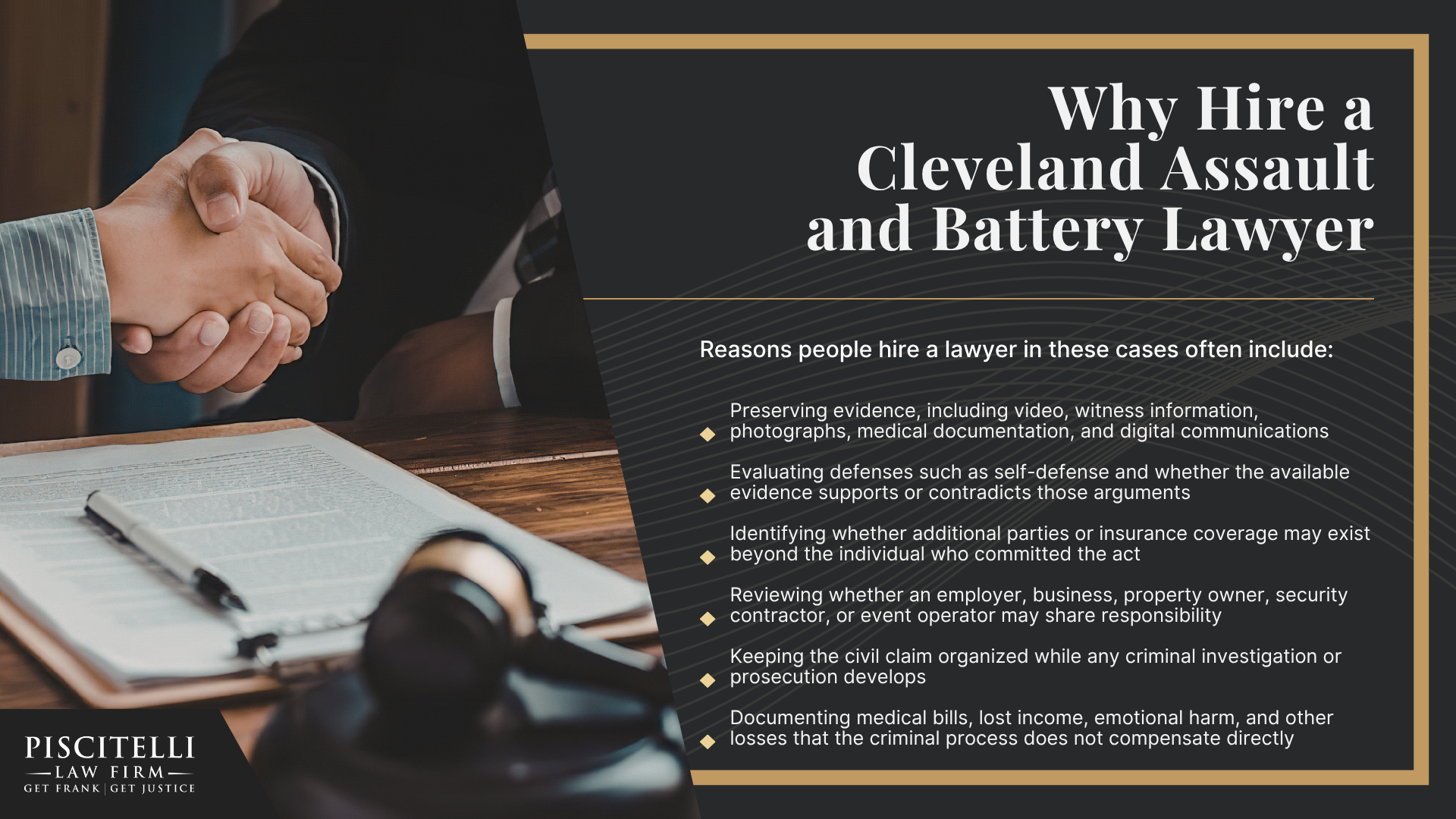
Reasons people hire a lawyer in these cases often include:
Preserving evidence, including video, witness information, photographs, medical documentation, and digital communications
Evaluating defenses such as self-defense and whether the available evidence supports or contradicts those arguments
Identifying whether additional parties or insurance coverage may exist beyond the individual who committed the act
Reviewing whether an employer, business, property owner, security contractor, or event operator may share responsibility
Keeping the civil claim organized while any criminal investigation or prosecution develops
Documenting medical bills, lost income, emotional harm, and other losses that the criminal process does not compensate directly
A civil assault or battery claim depends on the facts of the incident, the available evidence, and the damages caused by the conduct.
Assault usually involves an intentional threat or attempt that creates a reasonable fear of imminent harm, while battery involves harmful or offensive physical contact.
Conduct may be considered assault even if no physical contact occurred, but a battery claim generally requires contact, such as being struck, grabbed, shoved, restrained, or otherwise touched in a harmful or offensive way.
Ohio criminal charges may use terms such as assault charge or aggravated assault, but the civil case still focuses on proof of wrongdoing, causation, damages, and any available source of recovery.
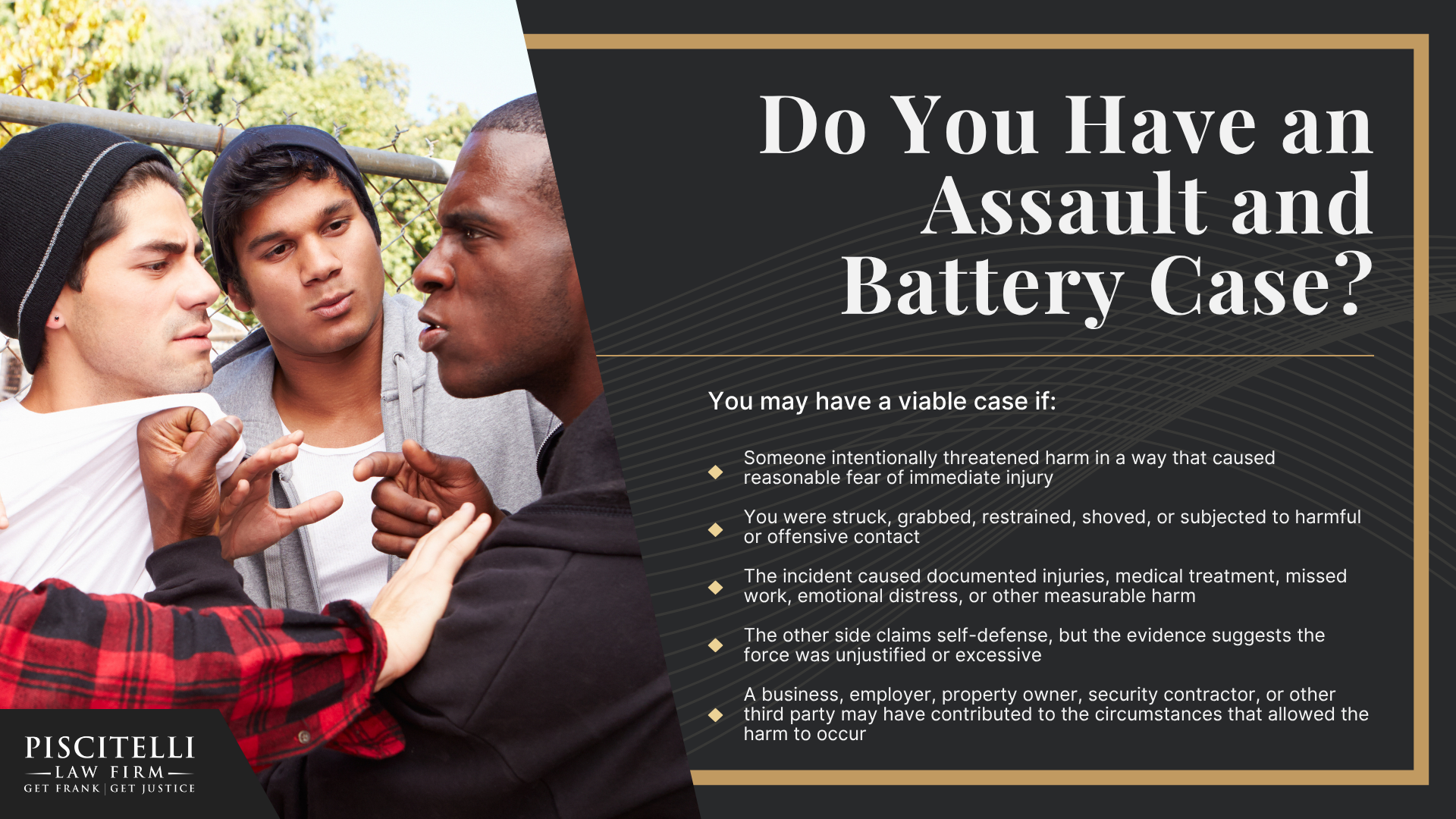
You may have a viable case if:
Someone intentionally threatened harm in a way that caused reasonable fear of immediate injury
You were struck, grabbed, restrained, shoved, or subjected to harmful or offensive contact
The incident caused documented injuries, medical treatment, missed work, emotional distress, or other measurable harm
The other side claims self-defense, but the evidence suggests the force was unjustified or excessive
A business, employer, property owner, security contractor, or other third party may have contributed to the circumstances that allowed the harm to occur
A criminal record, prior incident history, or related criminal filing may be relevant in some cases, but it does not automatically prove civil liability.
The civil claim should be evaluated based on the evidence, the injuries, the available defendants, and whether there is a practical path to compensation under Ohio law.
Who Can Be Held Liable in an Assault and Battery Case?
The person who committed the assault or battery may be legally responsible for the harm, but civil recovery often depends on whether another party also contributed to the circumstances surrounding the violent crime.
A case may involve a business, employer, property owner, event operator, or security contractor if that party had control over the setting, responsibility for supervision or safety, or a duty to respond to known risks.
This analysis is important because a civil claim may require identifying available insurance coverage or another legally responsible party beyond the individual who caused the harm.
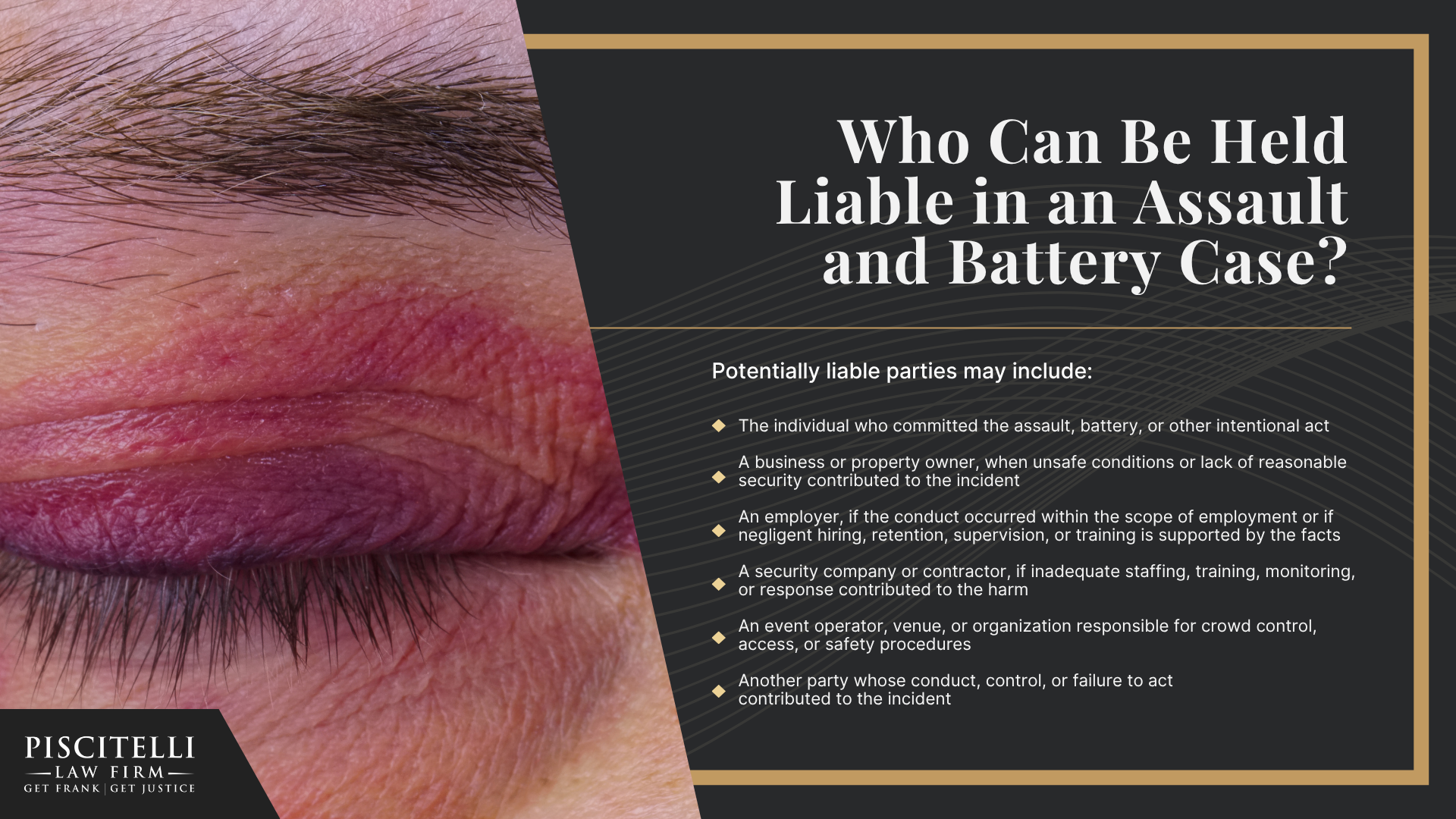
Potentially liable parties may include:
The individual who committed the assault, battery, or other intentional act
A business or property owner, when unsafe conditions or lack of reasonable security contributed to the incident
An employer, if the conduct occurred within the scope of employment or if negligent hiring, retention, supervision, or training is supported by the facts
A security company or contractor, if inadequate staffing, training, monitoring, or response contributed to the harm
An event operator, venue, or organization responsible for crowd control, access, or safety procedures
Another party whose conduct, control, or failure to act contributed to the incident
A lawyer can evaluate how the criminal and civil issues interact, what records may be obtained, and whether defenses such as self-defense are supported by the evidence.
Police reports, medical records, surveillance video, witness statements, employment records, security policies, and prior complaints may all affect the liability analysis.
A free consultation can help determine whether the evidence supports a civil claim and whether there is a practical recovery path under Ohio law.
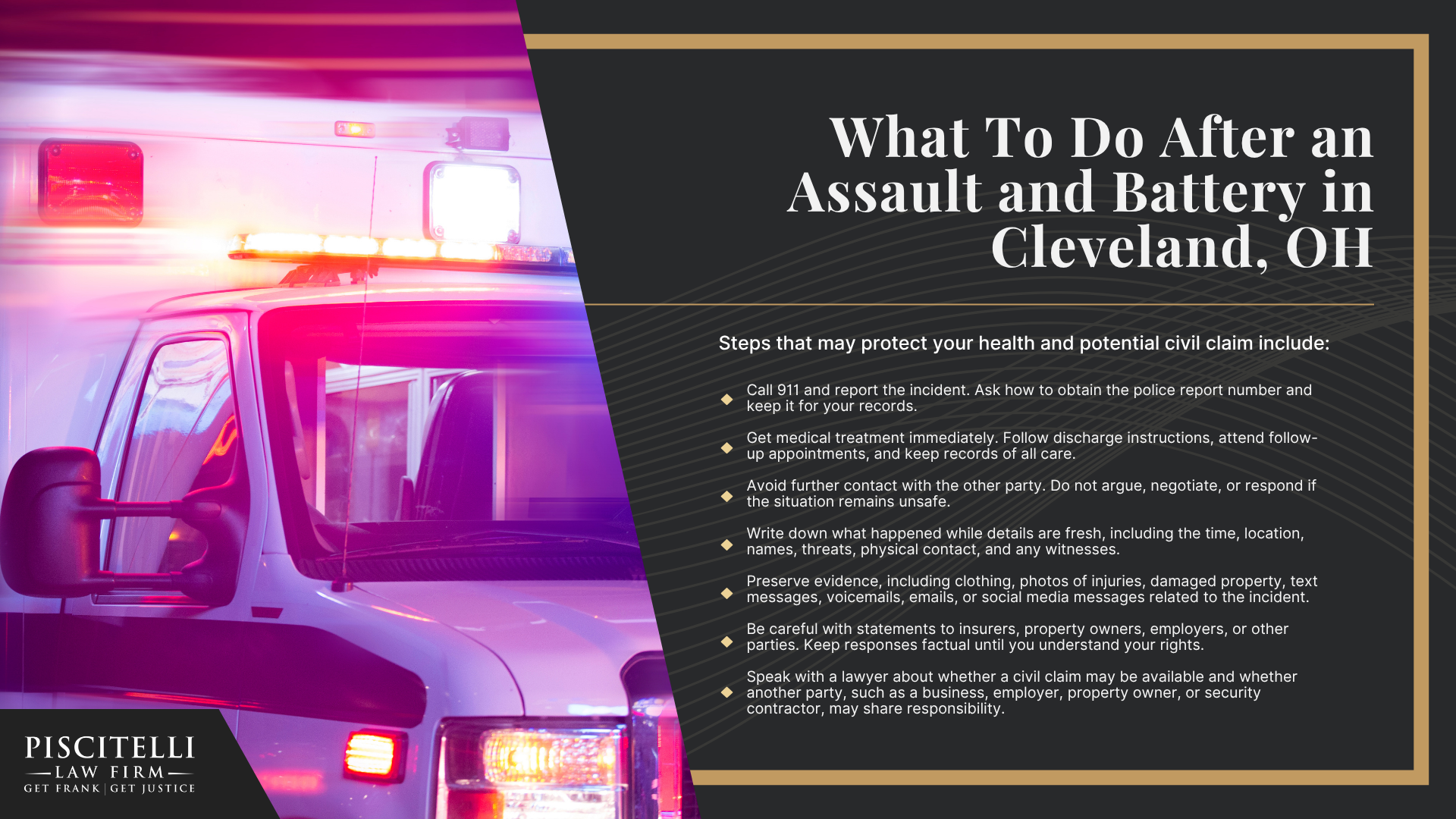
What To Do After an Assault and Battery in Cleveland, OH
After an assault or battery, safety and medical care come first.
If you are in danger, call 911, move to a secure location, and request emergency help.
Even if injuries seem manageable, seek medical evaluation because bodily harm may not be fully apparent at the scene, and medical records can become important in later legal matters.
Steps that may protect your health and potential civil claim include:
Call 911 and report the incident. Ask how to obtain the police report number and keep it for your records.
Get medical treatment immediately. Follow discharge instructions, attend follow-up appointments, and keep records of all care.
Avoid further contact with the other party. Do not argue, negotiate, or respond if the situation remains unsafe.
Write down what happened while details are fresh, including the time, location, names, threats, physical contact, and any witnesses.
Preserve evidence, including clothing, photos of injuries, damaged property, text messages, voicemails, emails, or social media messages related to the incident.
Be careful with statements to insurers, property owners, employers, or other parties. Keep responses factual until you understand your rights.
Speak with a lawyer about whether a civil claim may be available and whether another party, such as a business, employer, property owner, or security contractor, may share responsibility.
Criminal charges, including simple assault, may proceed in court separately from a civil claim for damages.
The criminal case focuses on prosecution, while the civil claim focuses on compensation for medical bills, lost income, emotional harm, and other losses.
A lawyer can explain how the timelines may overlap and what records may be useful in the civil case.
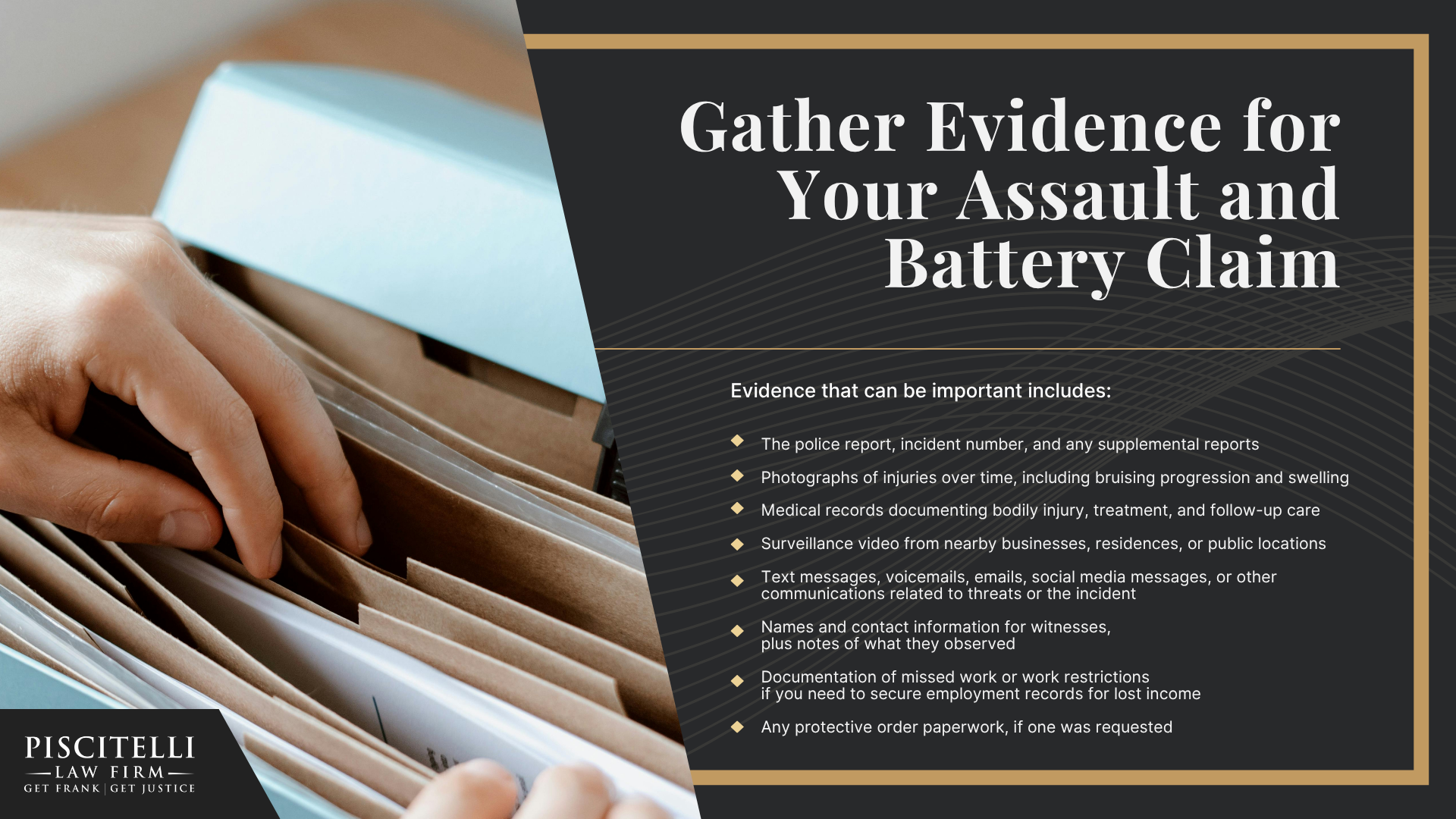
Gather Evidence for Your Assault and Battery Claim
Assault cases and battery cases often come down to whether you can present evidence that is consistent, specific, and supported by records.
Your legal team will typically focus on building a clear timeline, identifying witnesses, and preserving objective documentation before it disappears.
Evidence that can be important includes:
The police report, incident number, and any supplemental reports
Photographs of injuries over time, including bruising progression and swelling
Medical records documenting bodily injury, treatment, and follow-up care
Surveillance video from nearby businesses, residences, or public locations
Text messages, voicemails, emails, social media messages, or other communications related to threats or the incident
Names and contact information for witnesses, plus notes of what they observed
Documentation of missed work or work restrictions if you need to secure employment records for lost income
Any protective order paperwork, if one was requested
A strong investigation often includes interviewing witnesses early, because memories change quickly.
The civil claim can also involve anticipating the other side’s defense, including self-defense arguments, and organizing records that address those claims with objective proof.
If there is a parallel criminal proceeding, you may hear about criminal defense strategy, but your attorney’s role in the civil case is to focus on evidence, damages, and accountability.
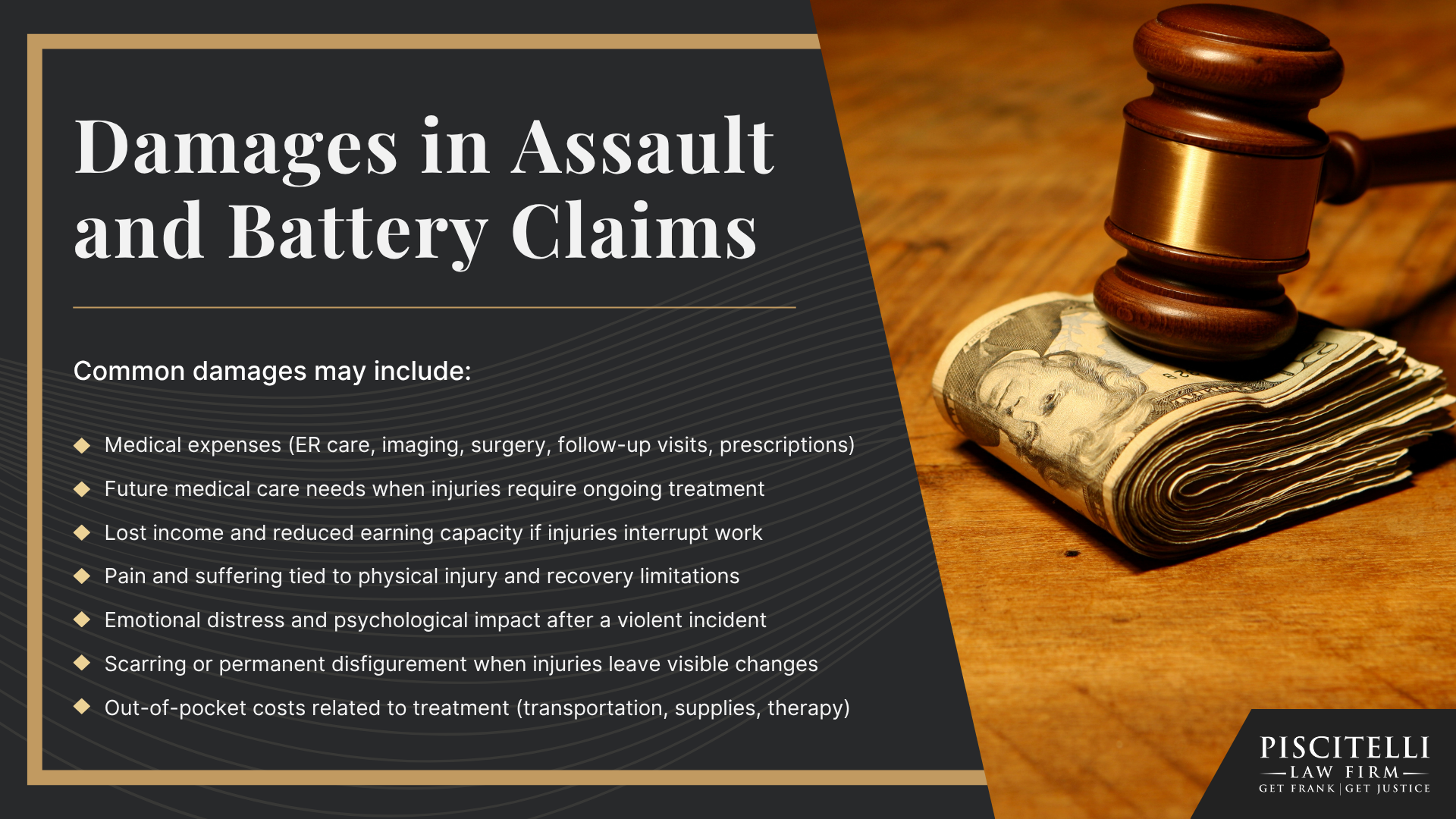
Damages in Assault and Battery Claims
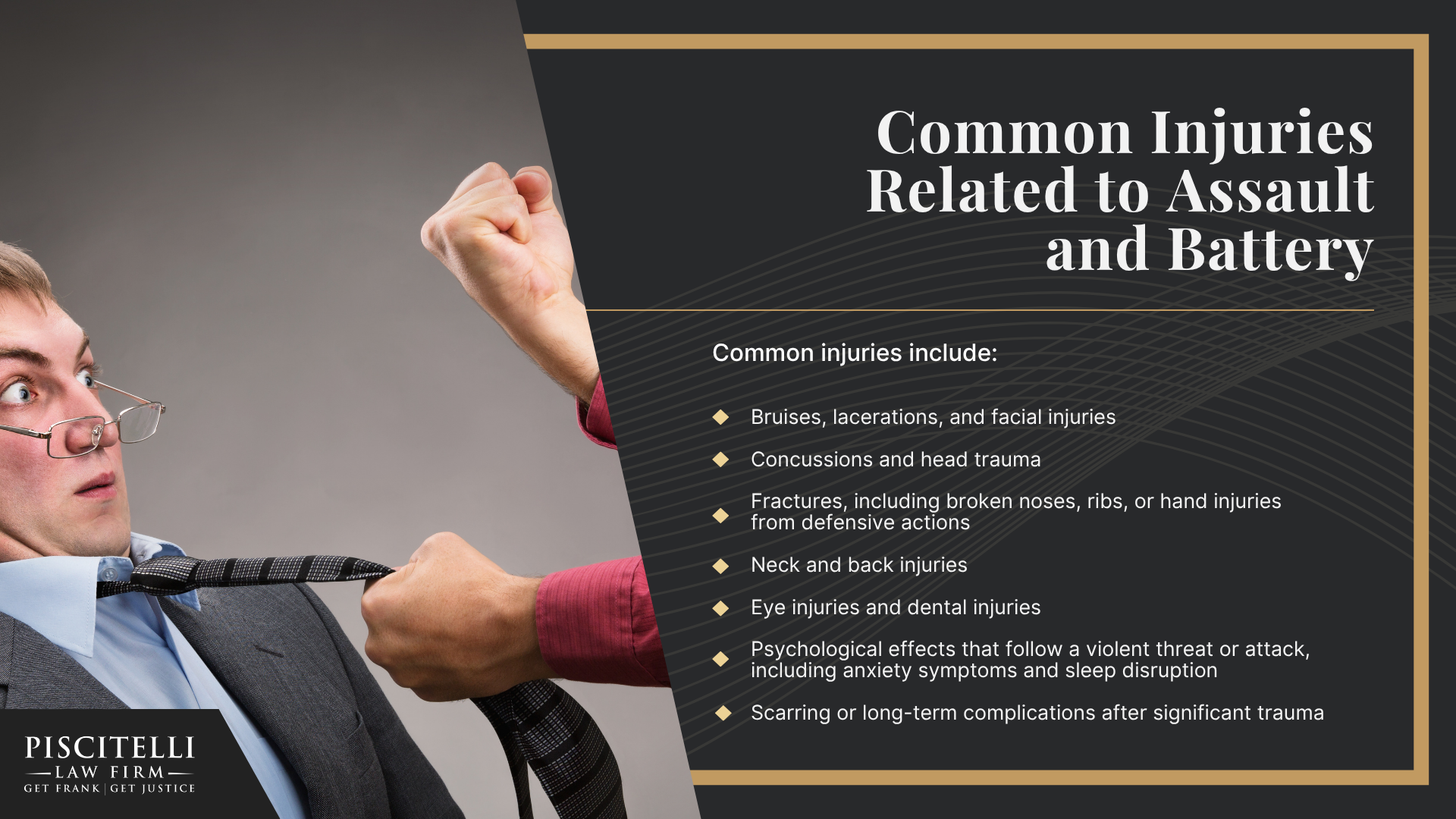
Damages in assault and battery claims typically include both economic losses (financial costs) and non-economic losses (the human impact).
The damages depend on the severity of the physical harm, the treatment required, and how long symptoms persist.
Common damages may include:
Medical expenses (ER care, imaging, surgery, follow-up visits, prescriptions)
Future medical care needs when injuries require ongoing treatment
Lost income and reduced earning capacity if injuries interrupt work
Pain and suffering tied to physical injury and recovery limitations
Emotional distress and psychological impact after a violent incident
Scarring or permanent disfigurement when injuries leave visible changes
Out-of-pocket costs related to treatment (transportation, supplies, therapy)
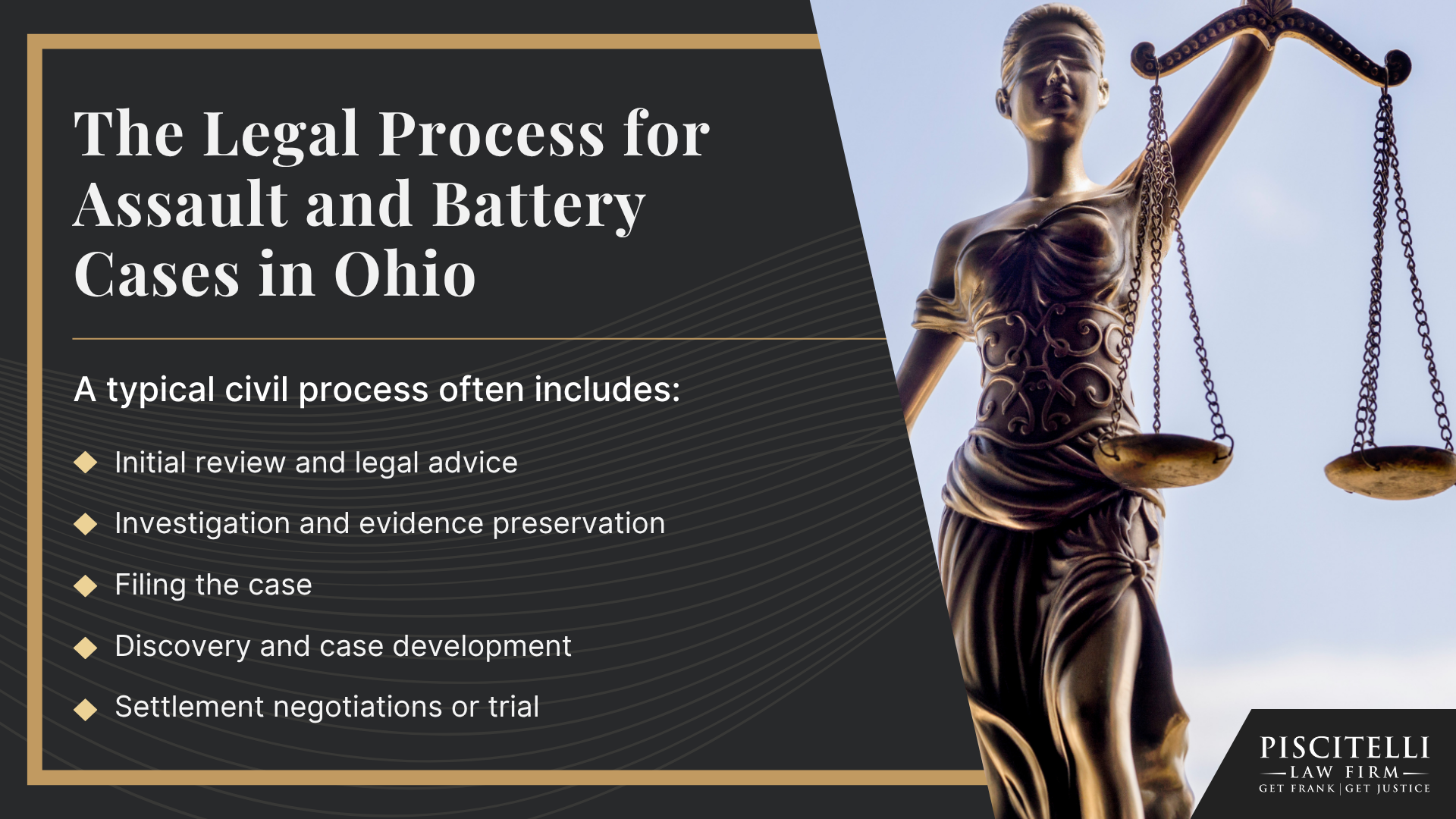
The Legal Process for Assault and Battery Cases in Ohio
An assault battery case can involve both the criminal justice system and a separate civil claim.
A criminal matter is handled by the state and can lead to an arrested defendant, criminal offenses, and consequences like a fine, jail, or prison if the person is convicted.
A civil case is different.
It is a process where the victim may be able to sue the person who caused harm and seek compensation for injuries, medical costs, and other losses.
A typical civil process often includes:
Initial review and legal advice: The firm reviews what happened, what evidence exists, and whether the facts support claims for assault, battery, or both. The attorney will explain how the civil matter can move forward even if the criminal case is still pending.
Investigation and evidence preservation: Collecting records, reviewing police documentation, identifying witnesses, and preserving video or other proof. Many cases turn on intent, the nature of the threat, and what occurred during the act.
Filing the case: If settlement is not appropriate early, the lawyer may file a civil lawsuit against the defendant and identify any additional responsible parties when the incident involved a business, a property setting, or an employer-related situation.
Discovery and case development: Exchanging information, taking witness statements and depositions, and organizing medical documentation to prove injury and damages.
Settlement negotiations or trial: Some cases resolve by agreement. Others proceed to trial, where a judge or jury weighs the evidence and decides liability and damages.
Throughout the process, the firm’s job is to represent clients with clear communication, careful preparation, and hard work focused on what can be proven, not assumptions.
The criminal case may end in a conviction or dismissal, but the civil case remains focused on damages and accountability under Ohio law.
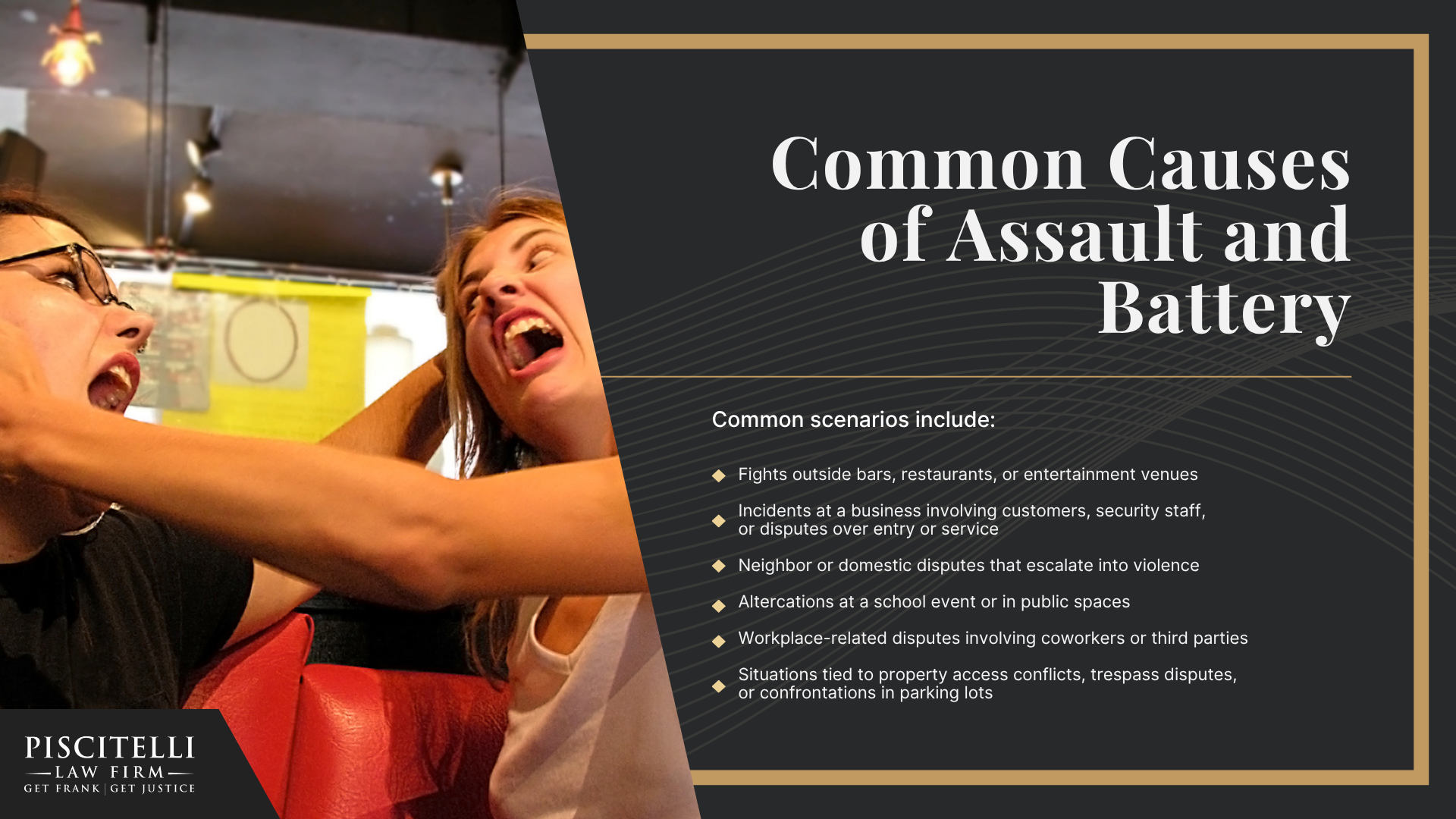
Assault and battery incidents arise in many settings across the community.
The underlying causes often involve a threat that escalates into physical contact, disputes that turn violent, or situations where alcohol, crowding, or poor supervision plays a role.
Common scenarios include:
Fights outside bars, restaurants, or entertainment venues
Incidents at a business involving customers, security staff, or disputes over entry or service
Neighbor or domestic disputes that escalate into violence
Altercations at a school event or in public spaces
Workplace-related disputes involving coworkers or third parties
Situations tied to property access conflicts, trespass disputes, or confrontations in parking lots
Each matter is fact-specific.
A lawyer will focus on who was involved, what was said and done, whether there was intent to cause harm, and what evidence supports the account.
Families and individuals often contact Frank Piscitelli when they want straight answers about legal options and what the process will require.
These cases can move quickly, especially when police are involved and statements are being gathered, and small details can become the turning point later.
Frank’s approach emphasizes careful investigation, clear explanations, and disciplined preparation focused on credible proof.
When the facts support it, the firm fights to hold the defendant accountable and to pursue compensation that reflects the real consequences of the harm.
That includes documenting injuries, identifying witnesses, and anticipating the defenses the other side may raise.
Clients also value practical guidance about how the criminal case and civil case can proceed at the same time, and what each track can and cannot accomplish.
The Piscitelli Law Firm: Your Cleveland Assault and Battery Lawyer
If you were harmed in an assault or battery incident in Cleveland, Piscitelli Law Firm can review what happened and explain what comes next.
The firm represents clients in serious injury matters and manages the legal work required to investigate, file the claim, and pursue a fair resolution through negotiation or trial when necessary.
If you want to understand your legal options and whether you can sue the responsible person or other involved parties, contact Piscitelli Law Firm to speak with a lawyer about your case.
You can also use the chatbot on this page to see if you qualify today.
A civil claim is a separate process from the criminal case, and it is focused on compensation for harm rather than punishment.
The state must prove criminal guilt beyond a reasonable doubt, but a civil case typically uses a lower standard, so a case may still move forward even if the defendant is not convicted.
A Cleveland assault and battery lawyer can explain what evidence matters for the civil filing and how the timelines may overlap with the criminal matter.
Assault is commonly alleged when a person intentionally threatens or attempts to cause harm in a way that creates a reasonable fear of imminent injury.
Battery generally involves harmful or offensive physical contact, so it often centers on what happened during the act and what injuries resulted.
Unlike assault, battery requires contact, which is why claims are often pleaded together when an incident involves both a threat and physical harm.
Call 911 if you are in danger, report the crime, and ask for the police report number so the incident is documented.
Seek medical care as soon as possible for bodily injury and keep records of treatment, because medical documentation is often the clearest proof of physical harm.
Preserve evidence like photos of injuries, clothing, and messages, and consider speaking with an attorney before giving detailed statements to insurers or investigators.
Self-defense arguments are common in assault cases and battery cases, and they can shape both the criminal case and the civil claim.
A civil legal team will focus on objective proof, including police records, medical records, video, and witness accounts, to evaluate whether the defense fits the facts or whether excessive force was used.
The goal is to present evidence that supports your account and undermines a “solid defense” narrative when it is not supported by credible documentation.
The primary defendant is often the person who committed the assault or battery, but liability can extend to a business, property owner, employer, or event operator when their actions or failures contributed to the circumstances of the harm.
Damages may include medical expenses, lost income, pain and suffering, emotional distress, and scarring or permanent disfigurement depending on the injuries and treatment required.
A lawyer can also explain how insurance coverage may apply and what recovery options are realistic based on the facts.
Member of the Ohio State Bar Association since 1993. With 30+ years of legal experience, Attorney Frank Piscitelli has secured over $55 million in compensation for Ohio injury victims, car accident victims, and surviving family members of Ohio wrongful death victims.
Legally Reviewed
This article has been written and reviewed for legal accuracy and clarity by the team of writers and attorneys at Piscitelli Law Firm and is as accurate as possible. This content should not be taken as legal advice from an attorney. If you would like to learn more about our owner and experienced Ohio personal injury lawyer, Frank Piscitelli, you can do so here.
Fact-Checked
Piscitelli Law Firm does everything possible to make sure the information in this article is up to date and accurate. If you need specific legal advice about your case, contact us. This article should not be taken as advice from an attorney.