
No fees unless we win.
Get a free consultation
•
3 Reviews
5.0
★★★★★

Elyria Fatal Car Accident Lawyer | Call (216) 931-7000

Lost a Loved One in a Fatal Car Accident in Elyria?

A fatal car accident can leave a family facing funeral costs, burial costs, lost financial support, and difficult insurance questions while grieving a loved one’s death.

When someone else’s negligence causes a deadly car crash, Ohio law allows qualifying surviving family members to pursue compensation through a wrongful death claim.

The claim is generally filed by the personal representative of the decedent’s estate, who serves as the legal representative for the claim rather than requiring each family member to sue individually.

A civil wrongful death case can proceed separately from any criminal actions, even if the other driver is not charged with a crime.

Piscitelli Law Firm represents families pursuing wrongful death claims after serious motor vehicle accidents in Elyria and throughout Lorain County.

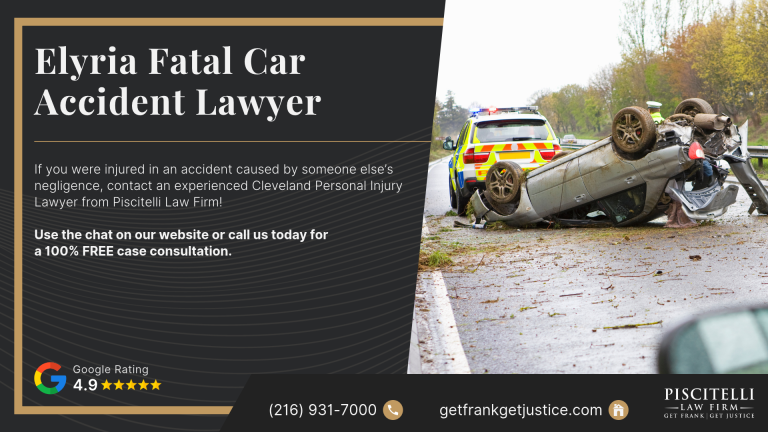
Elyria Fatal Car Accident Lawyer

Piscitelli Law Firm Represents Families After Fatal Car Accidents

Fatal collision claims involve more than repairing a vehicle or determining which driver received a traffic citation.

Families may need answers about the circumstances surrounding the crash, whether another person or business is responsible, and the financial burdens that surviving children, spouses, parents, and other qualifying relatives may face.

Frank Piscitelli has more than 30 years of experience representing Ohio injury victims and families affected by wrongful death.

He reports securing more than $55 million across his personal injury and wrongful death practice, although prior results do not predict the outcome of another claim.

Our law firm offers free consultations and accepts qualifying cases on a contingency fee basis.

Contact Piscitelli Law Firm to discuss your family’s legal options with an Elyria fatal car accident lawyer.

Why Choose Frank Piscitelli After a Fatal Car Accident?

A fatal car accident lawsuit may involve multiple insurance companies, disputed fault, and proof of both the cause of death and the family’s losses.

Families should look for a wrongful death attorney who understands fatal motor vehicle accidents, rather than assuming experience with general civil law or routine car accident cases is enough.

Families considering our law firm can evaluate the following:

  • More than 30 years of experience: Frank has represented Ohio clients in personal injury and wrongful death matters for decades.
  • Direct attorney involvement: Frank personally directs important decisions in the serious cases he accepts rather than assigning the case to another attorney.
  • Wrongful death experience: His published practice includes claims involving deaths caused by another party’s alleged negligence.
  • Local access: Piscitelli Law Firm maintains an Elyria office at 424 Middle Avenue, Suite 1.
  • Contingency fees: Attorney fees in qualifying cases are generally paid from a successful recovery rather than collected upfront, with responsibility for litigation expenses explained in the written agreement.

Many attorneys represent people injured in car crashes, but families should ask specific questions about the lawyer’s experience with fatal accident investigations, wrongful death beneficiaries, disputed fault, and the legal process.

Ask who will gather evidence, whether accident reconstruction specialists may be necessary, how quickly vehicles and video can be preserved, and who will evaluate a settlement offer or prepare the case for civil court.

Surveillance footage, vehicle data, and other evidence can disappear quickly, so prompt preservation is important even though no attorney can promise a successful outcome.


Who Can File a Fatal Car Accident Wrongful Death Claim in Ohio?

Under Ohio Revised Code Section 2125.02, an Ohio wrongful death lawsuit is generally brought in the name of the personal representative of the deceased person’s estate.

The representative may be an executor named in a will or an administrator appointed through probate court.

The representative files the legal action for the benefit of relatives recognized by Ohio law, rather than solely for the representative’s personal benefit.

Qualifying beneficiaries may include:

  • The deceased person’s surviving spouse
  • Children, including qualifying legally adopted children
  • Parents
  • Other qualifying next of kin

Ohio law presumes that a surviving spouse, child, or parent suffered a loss because of the death, subject to the statute’s qualifications.

Other next of kin generally must establish their compensable loss, and special rules govern notice and eligibility in some settlements.

Family members do not necessarily have to agree about the value of their individual losses before a wrongful death lawsuit can be filed.

For more detail about eligibility, see our guide to who can file a wrongful death lawsuit in Ohio.

How Is Wrongful Death Compensation Divided Among Family Members?

The personal representative does not automatically keep the money recovered through a wrongful death claim.

Under Ohio Revised Code Section 2125.03, wrongful death proceeds are distributed to eligible beneficiaries based on the statute and, where necessary, probate court review.

The court may consider each person’s relationship with the deceased, financial dependence, personal loss, and other relevant circumstances when allocating the recovery.

The law also treats compensation for reasonable funeral expenses and burial expenses separately: those funds are paid to the personal representative for payment or reimbursement of those expenses.

This process differs from distributing the deceased person’s ordinary property through a will or Ohio inheritance law.

What Should Families Do After a Deadly Car Accident in Elyria?

Families may receive calls from investigators, insurance companies, and other parties soon after a fatal collision, often before they know their legal rights or available financial resources.

There is no requirement to resolve every question immediately, but some steps can protect important records and prevent misunderstandings:

  1. Keep the crash information. Record the investigating agency, report number if available, collision date, location, and names of any known witnesses.
  2. Request available police records. The Elyria Police Department provides instructions for obtaining eligible crash reports online, although an ongoing investigation may affect when records are available.
  3. Preserve photographs and communications. Save any images, dashcam video, witness messages, repair or towing information, and letters from insurers.
  4. Identify where the vehicles are stored. A damaged vehicle may contain physical evidence or electronic crash data that could be lost through repair, disposal, or salvage.
  5. Keep funeral and financial documents. Preserve invoices, employment and benefits records, and information about the deceased person’s contributions to the household.
  6. Review insurance communications carefully. Insurers may dispute fault, deny coverage, or offer less than the family believes its losses justify, so an early payment is not necessarily a fair settlement.
  7. Address the estate representative and deadline. Ohio generally requires a wrongful death action to be filed within two years after death, even if insurance negotiations or probate matters remain unresolved.

For collisions investigated by Elyria Police, the city’s crash-report records page links to Ohio’s online crash retrieval service and explains when to contact police records directly.

Reports of collisions on private property may require a direct request to the department rather than the statewide online service.

Families may also need medical or coroner records, depending on the circumstances of the death and the investigation.

How an Elyria Fatal Car Accident Lawyer Can Help

A fatal accident claim requires proof of how the collision occurred, who may be responsible, and what losses are recognized under Ohio wrongful death law.

A lawyer may help establish fault and gather evidence when the family does not know which driver or business caused the death.

Depending on the circumstances, the legal review may involve crash reports, witness testimony, traffic-camera footage, vehicle damage, electronic event data, medical records, and available insurance policies.

Cases involving disputed speed, visibility, braking, or impact positions may require accident reconstruction specialists to assess the available physical and electronic records.

When a commercial vehicle is involved, employment relationships, driver logs, maintenance records, and company insurance can raise additional questions.

An attorney also evaluates whether the family has a wrongful death claim, whether a separate survival claim exists, and whether the estate has an authorized personal representative.

The Ohio car accident lawsuit guide explains the broader claim process, while the Ohio wrongful death lawsuit guide addresses the legal rights of surviving relatives.

Common Causes of Fatal Car Accidents in Elyria

Fatal car accidents may involve speeding, distraction, alcohol or drug impairment, unsafe turns, failure to yield, fatigue, or a combination of driver errors.

The circumstances of a fatal collision must be evaluated individually; a death does not establish that another driver was negligent.

Common causes and circumstances include:

  • Speeding and reckless driving: Excessive speed can increase stopping distance and impact severity or prevent a driver from responding to changing conditions.
  • Distracted driving: A driver may fail to see a stopped vehicle, traffic signal, or approaching car while using a phone or attending to something inside the vehicle.
  • Drunk driving and drug impairment: Alcohol or drugs can affect judgment, perception, and reaction time.
  • Failure to yield: Turning across oncoming traffic or entering an intersection against a signal can lead to deadly side-impact or head-on collisions.
  • Wrong-way and head-on collisions: A driver crossing the centerline or traveling in the wrong direction can cause fatal injuries to occupants of multiple vehicles.
  • Commercial vehicle crashes: A work-related collision may involve questions about the driver’s employer, maintenance, or applicable commercial insurance.
  • Hit-and-run collisions: The responsible motorist may leave the scene, creating additional identification and insurance issues.

Ohio has specific laws addressing speed and safe operation, impaired driving, and use of electronic wireless communication devices while driving.

A traffic citation or criminal charge may be useful evidence, but the family must still prove liability and causation in the civil claim.

A family may seek justice through a civil claim even when no criminal conviction results.

Can a Family File a Claim if No Criminal Charges Are Filed?

Yes, potentially.

Criminal prosecution and a civil wrongful death claim serve different purposes and have different burdens of proof.

Police and prosecutors decide whether criminal charges are warranted, while a civil lawsuit in civil court seeks compensation for legally recognized losses caused by negligent or wrongful conduct.

A family may have a claim even when the driver was not arrested, a citation was dismissed, or a criminal investigation remains open.

Who May Be Responsible for a Fatal Car Accident?

The at fault party is often a negligent driver, but responsibility may extend to others whose actions contributed to the death.

A negligent party may be held liable only when the applicable legal requirements, including causation, are established.

Depending on the evidence, potentially responsible parties include:

  • Another negligent driver
  • An employer when an employee caused the collision while acting within the scope of employment
  • A commercial vehicle operator or business responsible for a qualifying safety failure
  • A vehicle or component manufacturer when a product liability claim involving defective brakes, tires, or other equipment is supported by the evidence
  • A contractor or government entity in certain cases involving a dangerous roadway or obstruction
  • More than one driver whose actions contributed to the same crash

An employer is not automatically liable simply because an employee owned or drove a company vehicle.

The work being performed, the driver’s relationship with the business, and the circumstances of the trip may matter.

Claims against cities, counties, or other public entities are more restricted because Ohio generally provides governmental immunity, subject to specified exceptions and defenses under R.C. Section 2744.02.

What if the Deceased Driver Was Partly at Fault?

Ohio applies modified comparative-fault rules to negligence claims under R.C. Section 2315.33.

The deceased person’s own negligent conduct can affect a fatal accident claim, including the amount that may be recovered.

In general, a claim involving negligent driving may be barred if the deceased person’s share of fault exceeds 50%; otherwise, compensatory damages may be reduced by the assigned percentage.

For example, a finding of 20% fault may reduce an otherwise recoverable $500,000 compensatory award to $400,000, before other applicable adjustments.

The insurance company’s initial fault assessment is not necessarily the final legal determination.

Witness accounts, vehicle information, road markings, and video may provide a more complete explanation than an initial police report alone.

What Compensation Can Families Recover After a Fatal Car Accident?

Ohio’s wrongful death law recognizes both financial losses and the personal losses experienced by eligible surviving family members, including losses often described as non economic damages.

Under R.C. Section 2125.02, recoverable damages may include:

  • Loss of financial support the deceased person would reasonably have provided
  • Loss of household services and assistance
  • Loss of companionship, care, protection, advice, and guidance
  • Loss of prospective inheritance
  • Mental anguish suffered by qualifying beneficiaries
  • Reasonable funeral and burial expenses

These losses are not limited to the deceased person’s paycheck.

For example, a parent who regularly provided childcare, transportation, and household support may have contributed valuable services even without a traditional salary.

The amount recoverable depends on the relationships involved, available financial and personal evidence, liability, and applicable insurance coverage.

Loss of companionship and mental anguish are distinct from the emotional distress the deceased person may have experienced before death; Ohio law treats wrongful death and survival losses separately.

Ohio’s wrongful death statute directs that losses be assessed for the qualifying beneficiaries, rather than assuming every relative suffered the same amount.

What Is the Difference Between Wrongful Death and a Survival Action?

The two claims address different losses arising from the same fatal accident.

A wrongful death claim compensates qualifying survivors for their losses caused by the person’s death.

A survival action preserves certain claims that could have supported a personal injury lawsuit or property-damage action if the deceased person had lived, under R.C. Section 2305.21.

Depending on the facts, a survival claim may include medical expenses, unpaid medical bills, lost wages incurred before death, property damage, or pain and suffering the person consciously experienced between the collision and death.

A survival recovery generally belongs to the estate, whereas wrongful death proceeds are allocated to statutory beneficiaries.

Ohio does not allow punitive damages in a standalone wrongful death claim.

Under Rubeck v. Huffman, punitive damages may be available through a qualifying survival action when the deceased person sustained a recoverable injury or property loss before death and the evidence satisfies R.C. § 2315.21.

The statute generally requires proof of malice or qualifying aggravated misconduct, not simply the fact that negligence caused a death.

The same personal representative may bring both types of claims, but their damages and legal requirements should be evaluated separately.

Hit-and-Run Fatal Crashes and Insurance Coverage

When the responsible driver cannot be identified or lacks sufficient insurance, the family’s recovery options may depend on other applicable coverage.

Ohio does not require every auto insurance policy to include uninsured or underinsured motorist coverage, but policies that provide it may cover death resulting from an uninsured or inadequately insured driver’s conduct.

Under R.C. Section 3937.18, certain claims involving unidentified drivers require independent evidence corroborating that the unidentified motorist caused the death.

Witness statements, surveillance footage, physical debris, and other available records may be relevant.

Whether coverage applies depends on the insured person’s status, policy language, limits, and notice or filing conditions.

A family should not assume the deceased person’s own car insurance is the only potentially relevant policy or that a prompt payment offer resolves every available claim.

Insurance companies may seek to reduce or deny payment by disputing the at fault party’s responsibility, policy coverage, or the extent of the family’s losses.

How Long Do You Have to File a Fatal Car Accident Lawsuit in Ohio?

The Ohio wrongful death statute of limitations, R.C. § 2125.02(F), generally requires a lawsuit to be filed within two years after the person’s death.

This deadline is not ordinarily extended because the family has not completed the estate process, obtained every record, or finished insurance negotiations.

Different requirements may arise for claims involving defective vehicle parts, public entities, insurance contracts, or a collision outside Ohio.

A related survival action may also have its own filing deadlines, so families should not assume one deadline covers every potential claim.

Missing an applicable filing deadline may prevent the claim from being heard on its merits.

Prompt review also matters because vehicle data may be lost, damaged cars may be released to salvage, and video recordings may be overwritten.

Speak With Frank Piscitelli About an Elyria Fatal Car Accident

After a deadly crash, surviving family members may face immediate expenses, unanswered questions, and pressure to make insurance decisions before the full circumstances are known.

When another person’s negligence caused the death, a family may pursue justice and compensation through an Ohio wrongful death claim.

Frank Piscitelli represents Ohio families pursuing wrongful death claims and offers more than 30 years of personal injury and wrongful death experience.

Our Elyria office is located at 424 Middle Avenue, Suite 1, Elyria, Ohio 44035.

Contact Piscitelli Law Firm for a free consultation, call (440) 534-2900, or use the chat feature on this page to discuss the collision and your family’s legal options.

Frequently Asked Questions

Published by:
Share
Picture of Frank Piscitelli
Frank Piscitelli

Member of the Ohio State Bar Association since 1993. With 30+ years of legal experience, Attorney Frank Piscitelli has secured over $55 million in compensation for Ohio injury victims, car accident victims, and surviving family members of Ohio wrongful death victims.


This article has been written and reviewed for legal accuracy and clarity by the team of writers and attorneys at Piscitelli Law Firm and is as accurate as possible. This content should not be taken as legal advice from an attorney. If you would like to learn more about our owner and experienced Ohio personal injury lawyer, Frank Piscitelli, you can do so here.

Piscitelli Law Firm does everything possible to make sure the information in this article is up to date and accurate. If you need specific legal advice about your case, contact us. This article should not be taken as advice from an attorney.

Additional Resources

Other cases we handle in Elyria
All
Car Accidents
Motorcycle Accidents
Other Accidents & Injuries
Truck Accidents
You can learn more about other cases we handle in Elyria below:
Elyria Assault and Battery Lawyer
Elyria Medical Malpractice Lawyer
Elyria Bicycle Accident Lawyer
Elyria Dog Bite Lawyer
Elyria Insurance Claim Lawyer
Elyria Negligent Security Lawyer
Elyria Premises Liability Lawyer
Elyria Spinal Cord Injury Lawyer
Elyria Brain Injury Lawyer
Elyria Catastrophic Injury Lawyer
Elyria Daycare Injury Lawyer
Elyria Nursing Home Abuse Lawyer
Elyria Wrongful Death Lawyer
Elyria Slip and Fall Lawyer
Elyria Pedestrian Accident Lawyer
Elyria DUI Accident Lawyer
Elyria Public Transportation Accident Lawyer
Elyria Burn Injury Lawyer
Elyria Car Accident Lawyer
Elyria Truck Accident Lawyer
Elyria Motorcycle Accident Lawyer
Elyria Rideshare Accident Lawyer
Personal Injury Lawyer Elyria, Ohio
Were you or a loved one injured in Elyria?

A serious injury can have life-altering results.

Don’t settle for less than you deserve, speak with an award-winning personal injury lawyer today.

•
3 Reviews
5.0
★★★★★
Recovered damages
$50 Million+

Table of Contents

Practice Areas
About Piscitelli Law

For 30 years, Frank Piscitelli has been fighting for clients who have been the victims of the wrongful death of a loved one.

Do you believe you’re entitled to compensation?

Use our Instant Case Evaluator to find out in as little as 60 seconds!

Guides & Resources
Edit Template

Other Elyria Personal Injury Cases

All
Car Accidents
Motorcycle Accidents
Other Accidents & Injuries
Truck Accidents
Local Elyria Resources
Education
Emergency Services
Courthouses
Department of Motor Vehicles
Sights to See