No fees unless we win.
Get a free consultation
•
3 Reviews
5.0
★★★★★

Elyria Bicycle Accident Lawyer | Call (216) 931-7000

Injured While Cycling in Elyria? Speak With a Local Attorney

A bike accident in Elyria can leave a rider with medical expenses, lost income, damaged equipment, and lasting physical limitations.

When another person’s negligence caused the collision, the injured cyclist may be able to pursue compensation.

Ohio law gives bicyclists the right to use public roads and requires drivers to follow traffic rules that protect people riding bicycles.

A driver may be responsible for a crash involving an unsafe turn, failure to yield, distracted driving, a close pass, or a vehicle door opened into the cyclist’s path.

An injured rider does not automatically lose the right to compensation because they were outside a bike lane or shared some responsibility for the crash.

Piscitelli Law Firm represents injured bicyclists in Elyria and Lorain County in claims involving disputed fault, insurance coverage, and serious injuries.

Elyria Bicycle Accident Lawyer

Piscitelli Law Firm Represents Injured Cyclists in Elyria

Bike riders are vulnerable road users because they have little protection from the force of a motor vehicle, even when the vehicle sustains relatively little damage.

A person struck while cycling may be thrown onto the pavement, into another vehicle, or against a curb, resulting in fractures, traumatic brain injuries, spinal cord damage, and injuries requiring prolonged rehabilitation.

When another party’s negligence causes the collision, an Elyria bicycle accident lawyer can help determine who may be responsible and what compensation is supported by the circumstances.

Frank Piscitelli represents people injured through negligence throughout Lorain County, including those with qualifying bicycle accident claims.

Frank Piscitelli has more than 30 years of experience representing Ohio injury victims and families pursuing wrongful death claims.

He has reported recovering more than $55 million for clients across his personal injury and wrongful death practice.

Our law firm offers free consultations and represents eligible injury clients on a contingency fee basis.

Contact Piscitelli Law Firm to discuss your legal rights after a bicycle crash in Elyria.

Why Choose Frank Piscitelli for an Elyria Bicycle Accident Claim?

Bicycle accident claims can involve disputed right-of-way, roadway positioning, limited insurance coverage, and injuries that affect a rider’s ability to work or live independently.

Frank Piscitelli brings more than 30 years of experience handling personal injury cases and direct involvement in the serious cases he accepts.

Clients considering our law firm can expect several established features of Frank’s approach:

  • Personal attention: Frank personally directs important decisions in the serious injury cases he accepts.
  • Experience with serious injuries: His personal injury practice includes motor vehicle accidents, catastrophic injuries, and wrongful death claims.
  • Preparation for disputed claims: The firm evaluates the evidence, available insurance, medical documentation, and whether litigation is necessary when a claim cannot be resolved through settlement.
  • Local access: Piscitelli Law Firm maintains an office at 424 Middle Avenue, Suite 1, in Elyria.
  • Contingency-fee representation: Attorney fees for eligible injury claims are generally paid from a successful recovery rather than charged upfront; the representation agreement explains how case expenses are handled.

An avid cyclist or a lawyer involved in bicycle advocacy may understand riding conditions, but those interests alone do not establish experience handling injury litigation.

When comparing firms that advertise the combined experience of a team of other attorneys, ask who will actually handle the case and whether you can regularly speak with that lawyer.

Frank personally directs the serious cases he accepts.

His past results do not predict the settlement or jury verdict in another case.

What to Do After a Bicycle Accident in Elyria

After a bike crash, obtaining medical treatment and preserving information about the collision should take priority.

If you are able to act safely after the collision, consider the following steps:

  1. Call 911 when necessary. Request emergency assistance for serious injuries and report the collision to police, particularly when a motor vehicle is involved.
  2. Seek medical treatment. Head injuries, internal injuries, and some neck or back conditions may not be immediately apparent.
  3. Record the crash location. Photograph the roadway, traffic signs, intersections, vehicle positions, skid marks, debris, and visible injuries if you can do so safely.
  4. Identify the driver and witnesses. Exchange contact and insurance information and obtain witness names before people leave the area.
  5. Preserve your bicycle and equipment. Keep the damaged bicycle, helmet, clothing, lights, cycling computer, and other items in their post-crash condition when possible.
  6. Save digital information. Ride-tracking applications, GPS records, dashcams, and nearby business or residential cameras may help establish the route and circumstances of the collision.
  7. Be cautious with insurance adjusters. Report the incident as required by applicable policies, but avoid speculating about fault or agreeing to a final settlement before the injuries and coverage are understood.

Medical records help connect the collision to diagnosed injuries and document ongoing symptoms, treatment, and limitations.

Preserving the bicycle can be particularly important when disputed impact angles, defective equipment, or allegations about lighting are involved.

How an Elyria Bicycle Accident Lawyer Can Help

An injury claim generally requires proof that another person or entity owed a legal duty, failed to meet that duty, and caused compensable harm.

In bicycle accidents, the dispute may concern whether a driver yielded, how much space was available for passing, or whether the cyclist was lawfully positioned on the road.

Legal representation may involve reviewing the crash report, documenting the bicycle and vehicle damage, assessing witness accounts, and determining which traffic rules apply to the location.

Video from nearby businesses or vehicles, when available, may help resolve disagreement about a turn, traffic signal, or passing maneuver.

Medical records, employment records, and future treatment needs may be relevant to calculating the full effect of the injuries.

The claim process may also involve disputed car insurance coverage, negotiations with insurance adjusters, or a decision whether to file a personal injury lawsuit in Ohio.

The specific investigation depends on the accident and available information, and not every case requires expert testimony or litigation.

Ohio and Elyria Bicycle Laws

Ohio bike law treats bicyclists as lawful roadway users while requiring them to follow applicable traffic rules.

Those requirements protect bicycle safety and also help establish the duties of motorists and riders after a collision.

Under Ohio Revised Code § 4511.52, cyclists may be cited for violating applicable traffic laws, although bicycle traffic violations do not result in driver’s-license points under that section.

Drivers must also recognize bicyclists when yielding, turning, overtaking, and entering roadways or intersections.

Do Bicyclists Have to Ride on the Right Side of the Road?

Ohio Revised Code § 4511.55 generally requires bicyclists to ride as near the right side of the roadway as practicable.

However, riders do not have to stay at the road’s edge when it would be unreasonable or unsafe.

Cyclists may move away from the edge to avoid parked cars, potholes, moving vehicles, other hazards, or a lane too narrow for a bicycle and motor vehicle to travel safely side by side.

The law also generally allows no more than two cyclists to ride abreast in a single lane, except in areas reserved for bicycles.

An insurance company’s assertion that a cyclist should have been farther right must be evaluated against the actual roadway conditions.

Ohio’s Three-Foot Passing Rule and Dooring Law

Under Ohio Revised Code § 4511.27, three feet or more is considered a safe passing distance when a motorist overtakes a bicycle or electric bicycle.

The motorist must also complete the pass safely before returning to the right side of the roadway.

A passing driver who crowds or sideswipes a cyclist may be responsible if the unsafe maneuver causes injuries.

Ohio also prohibits opening a car door into moving traffic unless it is reasonably safe and does not interfere with traffic under § 4511.70(C).

A cyclist who strikes an unexpectedly opened door may suffer injuries from the door itself, a fall, or a secondary collision with another vehicle.

Are Bicycles Allowed on Sidewalks in Elyria?

Ohio generally permits ordinary bicycle riding on sidewalks unless an applicable local restriction prohibits it.

State law does not require cyclists to use sidewalks instead of the roadway, and Ohio Revised Code § 4511.711 expressly permits local authorities to regulate sidewalk bicycle use.

Elyria Codified Ordinance § 373.10 prohibits riding bicycles in Ely Square and on certain downtown sidewalks, including specified portions of Broad Street, Middle Avenue, Court Street, East Avenue, and West Avenue.

The city’s published ordinance also restricts bicycle operation within the right-of-way of John F. Kennedy Memorial Parkway, subject to limited exceptions for emergencies, intersections, and pedestrian crossings under § 373.11.

Whether a sidewalk or roadway restriction applies to a crash depends on the precise location and the ordinance in effect at the time.

A claimed traffic violation does not, by itself, establish that a cyclist caused the collision or relieve a motorist of responsibility for negligent driving.

Bicycle Lights, Brakes, and Electric Bikes

Under Ohio Revised Code § 4511.56, a bicycle used during the specified low-light periods must have a white front lamp, a red rear lamp, and a rear red reflector.

A single rear lamp may satisfy both rear requirements if it also meets the statute’s reflector specifications.

Bicycles used on streets and highways must also have an adequate brake.

These requirements may become relevant after a nighttime accident when a driver claims the cyclist was difficult to see.

Ohio separately regulates electric bicycles, including restrictions on where certain classes may use shared-use paths and helmet requirements for class 3 riders and passengers under § 4511.522.

The bicycle’s classification and the rules governing the path or street determine which requirements apply.

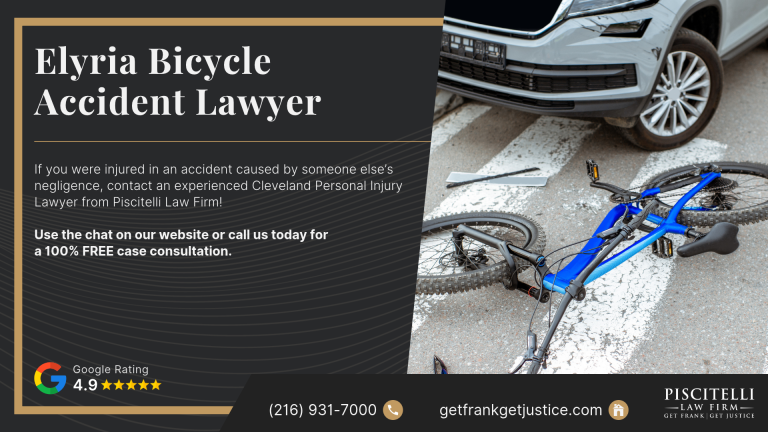
Common Causes of Bicycle Accidents in Elyria

Careless drivers may cause collisions by overlooking bike riders, turning across their paths, or passing without sufficient space.

Common causes of bicycle accidents include:

  • Failure to yield: A motorist turns or enters an intersection without yielding to a cyclist who has the right-of-way.
  • Unsafe passing: A driver overtakes a bicycle too closely, forcing the cyclist off balance or striking the bike.
  • Dooring: A driver or passenger opens a vehicle door in the path of an approaching rider.
  • Right- and left-turn collisions: A driver crosses a bicycle’s line of travel while turning at a signal, driveway, or parking-lot exit.
  • Distracted or impaired driving: A motorist fails to notice or respond to the cyclist because attention, judgment, or reaction time is affected.
  • Rear-end collisions: A driver follows too closely or fails to slow for a bicycle traveling ahead.
  • Road hazards: Broken pavement, debris, construction conditions, or defective bicycle equipment contribute to a fall or collision.

A right-turn collision may occur when a motorist overtakes a cyclist and then turns across the bicycle’s path without enough separation.

A left-turn collision may involve a driver who misjudges the speed or distance of an oncoming bicycle.

Dooring and close-passing crashes often depend on the cyclist’s lane position, the available clearance, and photographs showing the location of impact.

A traffic citation may support a claim, but a cyclist does not need a citation to pursue civil compensation.

Eyewitness testimony may support a claim even when police did not issue a ticket, particularly if a witness saw the signal, vehicle movement, or impact.

Fault depends on the applicable law and evidence connecting the conduct to the injuries.

Who Can Be Held Liable for a Bicycle Accident?

The driver who struck the cyclist may be liable when negligent conduct caused the crash, but not every bicycle accident involves only one responsible party.

Depending on the circumstances, a claim may involve the following parties:

  • A negligent car, truck, or delivery driver
  • An employer legally responsible for a worker’s driving
  • Another motorist whose actions contributed to the collision
  • A government entity or contractor responsible for a qualifying roadway defect
  • A manufacturer or supplier of a defective bicycle component

A collision involving a commercial vehicle may raise questions about the driver’s employment, vehicle ownership, company insurance, and whether other parties contributed to the accident.

If a bicycle component failed, the condition of the product and its role in the crash may warrant a separate product-liability analysis.

What If the Cyclist Was Partly at Fault?

Ohio follows a modified comparative-negligence rule.

Under Ohio Revised Code § 2315.33, an injured cyclist may generally recover compensatory damages if their share of fault is no greater than the combined fault attributed to the other responsible parties.

That usually means recovery is possible when the cyclist is 50% or less at fault, but the amount is reduced by the cyclist’s percentage of responsibility.

For example, if a cyclist’s compensatory damages total $100,000 and the cyclist is 20% responsible, the amount would generally be reduced to $80,000 before other possible adjustments.

An allegation that the cyclist moved unexpectedly, crossed against a signal, or lacked proper lighting does not automatically settle the fault question.

The driver’s speed, right-of-way, attention, passing distance, and opportunity to avoid the collision must also be considered.

Can a Cyclist Sue Over an Unsafe Road or Pothole?

A crash caused by broken pavement, an obstruction, a dangerous construction condition, or an uncovered opening may require identifying the party responsible for that location.

An injured cyclist may be able to bring a claim against a municipality or other local governments when a road condition falls within an exception to Ohio’s governmental-immunity rules.

Ohio’s political-subdivision immunity statute generally protects these entities from lawsuits, but it recognizes a limited exception for negligent failure to keep public roads in repair or remove obstructions.

A bicycle accident lawyer must assess the roadway’s condition, who was responsible for it, and any applicable immunity defenses.

The presence of a pothole alone does not establish municipal liability.

Cases involving a private contractor, utility, or defective bicycle part may raise different questions of responsibility.

Bicycle Accidents on Elyria Roads and Trails

Elyria includes downtown streets, designated bicycle routes, and recreational trails that connect riders to parks and neighboring communities.

The Black River Bikeway runs more than 11 miles between Elyria and Lorain, connecting the North Coast Inland Trail, Cascade Park, and Black River Reservation.

According to Lorain County Metro Parks, parts of the bikeway travel through Elyria on public roads and sidewalks rather than entirely separated paths.

These transitions can create questions about the applicable traffic signals, crossings, sidewalk restrictions, and the responsibilities of turning drivers.

Elyria’s published bicycle-route ordinance also identifies routes using streets including Broad Street, Washington Avenue, and North Abbe Road.

Bicycle advocates and local bicycle advocacy organizations may promote projects intended to make roads safer.

Such efforts, or a roadway’s status as a designated bike route, do not establish that a particular location was negligently maintained.

The road design, traffic controls, and location of impact determine which duties may apply.

Common Injuries in Bicycle Accident Claims

Cyclists can experience two separate impacts in a motor vehicle collision: the initial contact with the vehicle and the subsequent fall onto the roadway or another object.

These forces may result in serious injuries such as:

  • Concussions and traumatic brain injuries
  • Facial injuries, dental trauma, and skull fractures
  • Broken wrists, arms, legs, hips, and shoulders
  • Spinal cord injuries and lasting nerve damage
  • Neck and back injuries
  • Internal bleeding and organ injuries
  • Road rash, deep cuts, and permanent scarring
  • Emotional trauma following a serious collision

A helmet can reduce some injury risks, but it cannot prevent every brain injury or eliminate the force of a motor vehicle impact.

Some symptoms develop or become apparent after the initial accident, making appropriate medical assessment and accurate records important.

Severe bicycle injuries may require surgery, physical therapy, occupational rehabilitation, mobility assistance, or changes to a person’s home and work routine.

Compensation for an Elyria Bicycle Accident

A cyclist injured through another person’s negligence may seek compensation for both measurable financial losses and the personal consequences of the injury.

Economic damages may include:

  • Emergency medical treatment, hospitalization, and surgery
  • Follow-up care, medication, and physical therapy
  • Future treatment and rehabilitation needs
  • Lost wages and reduced earning capacity
  • Repair or replacement of the bicycle, helmet, and other damaged property
  • Medical transportation, assistive equipment, and necessary home care

Noneconomic damages may include pain and suffering, emotional distress, disfigurement, permanent limitations, and loss of enjoyment of daily activities.

Ohio generally does not cap proven economic damages in an ordinary negligence case, while Ohio Revised Code § 2315.18 places limits on many noneconomic damage awards and recognizes exceptions for certain severe permanent injuries.

The value of an individual claim depends on liability, comparative fault, available insurance, the medical prognosis, and the losses supported by documentation.

For more information about calculating losses, see our explanation of personal injury damages in Ohio.

Hit-and-Run Bicycle Accidents and Insurance Coverage

An injured cyclist may still have compensation options when a driver leaves the scene, lacks insurance, or has liability limits that are insufficient to cover the losses.

When the driver is identified, the driver’s liability car insurance may provide a source of compensation, subject to the policy’s coverage.

Depending on the policy, an injured rider may also qualify for uninsured or underinsured motorist benefits under an applicable auto insurance policy, even though the injured person was riding a bicycle rather than driving a car.

Ohio does not require every automobile policy to include uninsured or underinsured motorist coverage.

For certain claims involving an unidentified driver, Ohio Revised Code § 3937.18 requires independent evidence corroborating the uninsured motorist’s involvement.

Video, witness accounts, debris, and physical damage may therefore be important in a hit-and-run investigation.

Coverage depends on who qualifies as an insured, the policy terms, and any notice or contractual deadlines.

How Long Do You Have to File a Bicycle Accident Lawsuit in Ohio?

Under Ohio Revised Code § 2305.10, most personal injury and personal-property-damage lawsuits must be filed within two years after the claim accrues.

In an ordinary bicycle collision, the deadline generally runs from the injury or property damage.

Different rules may apply to claims involving children, certain product defects, previously dismissed cases, and other statutory exceptions.

An insurance claim may also have separate notice and contractual filing requirements, so the two-year personal injury deadline should not be assumed to govern every insurance dispute.

Prompt action can also matter because nearby video may be overwritten, road conditions can change, and witnesses may become difficult to locate.

When a loved one dies because of bicycle accident injuries, Ohio generally requires a wrongful death lawsuit to be filed within two years after the death under Ohio Revised Code § 2125.02.

The personal representative of the estate brings a qualifying wrongful death claim for the benefit of surviving family members identified by law.

Contact Piscitelli Law Firm About an Elyria Bicycle Accident

A bicycle collision may leave an injured person facing medical bills, lost wages, and a dispute over who should pay.

Frank Piscitelli represents injured people throughout Lorain County and brings more than 30 years of experience to personal injury cases.

Our Elyria office is located at 424 Middle Avenue, Suite 1, Elyria, Ohio 44035.

Contact Piscitelli Law Firm for a free consultation about your bicycle accident claim, call (440) 534-2900, or use the chat feature on this page.

Frequently Asked Questions

Published by:
Share
Picture of Frank Piscitelli
Frank Piscitelli

Member of the Ohio State Bar Association since 1993. With 30+ years of legal experience, Attorney Frank Piscitelli has secured over $55 million in compensation for Ohio injury victims, car accident victims, and surviving family members of Ohio wrongful death victims.


This article has been written and reviewed for legal accuracy and clarity by the team of writers and attorneys at Piscitelli Law Firm and is as accurate as possible. This content should not be taken as legal advice from an attorney. If you would like to learn more about our owner and experienced Ohio personal injury lawyer, Frank Piscitelli, you can do so here.

Piscitelli Law Firm does everything possible to make sure the information in this article is up to date and accurate. If you need specific legal advice about your case, contact us. This article should not be taken as advice from an attorney.

Additional Resources

Other cases we handle in Elyria
All
Car Accidents
Motorcycle Accidents
Other Accidents & Injuries
Truck Accidents
You can learn more about other cases we handle in Elyria below:
Elyria Assault and Battery Lawyer
Elyria Medical Malpractice Lawyer
Elyria Dog Bite Lawyer
Elyria Insurance Claim Lawyer
Elyria Negligent Security Lawyer
Elyria Premises Liability Lawyer
Elyria Spinal Cord Injury Lawyer
Elyria Brain Injury Lawyer
Elyria Catastrophic Injury Lawyer
Elyria Daycare Injury Lawyer
Elyria Nursing Home Abuse Lawyer
Elyria Wrongful Death Lawyer
Elyria Slip and Fall Lawyer
Elyria Public Transportation Accident Lawyer
Elyria Burn Injury Lawyer
Elyria Pedestrian Accident Lawyer
Elyria DUI Accident Lawyer
Elyria Car Accident Lawyer
Elyria Truck Accident Lawyer
Elyria Motorcycle Accident Lawyer
Elyria Rideshare Accident Lawyer
Personal Injury Lawyer Elyria, Ohio
Were you or a loved one injured in Elyria?

A serious injury can have life-altering results.

Don’t settle for less than you deserve, speak with an award-winning personal injury lawyer today.

•
3 Reviews
5.0
★★★★★
Recovered damages
$50 Million+

Table of Contents

Practice Areas
About Piscitelli Law

For 30 years, Frank Piscitelli has been fighting for clients who have been the victims of the wrongful death of a loved one.

Do you believe you’re entitled to compensation?

Use our Instant Case Evaluator to find out in as little as 60 seconds!

Guides & Resources
Edit Template

Other Elyria Personal Injury Cases

All
Car Accidents
Motorcycle Accidents
Other Accidents & Injuries
Truck Accidents
Local Elyria Resources
Education
Emergency Services
Courthouses
Department of Motor Vehicles
Sights to See