

No fees unless we win.
Get a free consultation
53 Reviews
4.9
★★★★★

Asacol Lawsuit | Malpractice Claims for Kidney Damage and Failure

Asacol (Mesalamine) Linked to Kidney Damage: Medical Malpractice Claims

Asacol lawsuit claims center on patients who were prescribed this drug and then left with permanent kidney damage because their doctors failed to monitor their kidney function.

The medication has been linked to serious renal complications, including chronic kidney disease and renal failure, when prescribers do not order routine bloodwork and respond promptly to early signs of injury.

Piscitelli Law Firm has successfully fought cases involving Asacol-related kidney damage, securing major compensation for clients whose kidney function was severely and permanently harmed after medical professionals failed to monitor their condition once Asacol was prescribed.

Asacol Lawsuit Malpractice Claims for Kidney Damage; Asacol (Mesalamine) Linked to Kidney Damage and Renal Failure; Types of Kidney Injury Linked to Asacol_Mesalamine; The Piscitelli Law Firm Has Secured Major Results for Victims of Asacol Malpractice; Asacol Medical Malpractice Lawsuit_ Do You Qualify; Gathering Evidence for an Asacol Medical Malpractice Claim; Possible Damages in Asacol Malpractice Cases; Piscitelli Law Firm_ Contact an Asacol Malpractice Lawyer Today

Our Law Firm Has Help Victims of Asacol Kidney Damage Seek Compensation

Asacol lawsuit claims center on patients who were prescribed this drug for inflammatory bowel disease or ulcerative colitis and were left with permanent kidney damage because their doctors failed to monitor their kidney function.

Many individuals develop stomach pain, fatigue, or unexplained changes in lab values that signal early renal impairment, yet these warnings often go unnoticed when providers do not conduct routine testing.

Asacol and other mesalamine products are associated with acute interstitial nephritis, a dangerous form of inflammation in the kidneys that can progress quickly when it is not identified.

The condition often develops silently, meaning patients may continue taking the drug while their kidneys sustain long-term injury.

In many cases, prolonged exposure to Asacol can lead to adverse kidney effects that evolve into chronic renal dysfunction.

Once this damage sets in, patients may suffer irreversible kidney failure even after discontinuing the medication.

Some ultimately progress to end-stage kidney disease and require lifelong treatment or transplant.

Because the harm is frequently permanent, waiting to see whether kidney function “returns to normal” can cost patients both their health and their legal rights.

Piscitelli Law Firm has successfully fought Asacol-related malpractice cases, securing significant compensation for clients whose kidney function was permanently damaged by medical professionals who failed to monitor their condition after prescribing this drug.

If you or a loved one took Asacol and later developed kidney problems or unexplained changes in kidney function, you may have experienced preventable harm and should speak with an attorney as soon as possible.

Contact Piscitelli Law Firm today for a free consultation.

Use the chat feature on this page to find out if you qualify for an Asacol malpractice lawsuit.

Asacol (Mesalamine) Linked to Kidney Damage and Renal Failure

Asacol is a brand of mesalamine delayed release tablets, a 5-aminosalicylic acid (5-ASA) drug used primarily to treat chronic inflammatory bowel disease, including ulcerative colitis.

It is designed to release mesalamine in the intestine, where it acts locally to reduce inflammation in the lining of the colon, and many patients are kept on the medication for years to control flares, stomach pain, and other symptoms of inflammatory bowel disease.

Asacol (mesalamine) is not a general pain or arthritis medication.

It is a bowel-targeted anti-inflammatory most often prescribed for ulcerative colitis and other inflammatory bowel diseases.

Some confusion comes from sulfasalazine, a related drug that is used in arthritis, but the risks discussed on this page involve mesalamine as a treatment for inflammatory bowel disease, not routine pain control.

Because Asacol is often prescribed for long-term management, patients treated with this drug may accumulate a significant cumulative exposure over time, which increases the importance of careful renal function monitoring throughout treatment.

From the drug’s earliest labeling, the FDA and manufacturer have warned that Asacol and related mesalamine delayed release tablets can injure the kidneys.

The Asacol prescribing information states that “renal impairment, including minimal change disease, acute and chronic interstitial nephritis, and renal failure, has been reported in patients taking products such as Asacol that contain mesalamine or are converted to mesalamine,” and directs prescribers to evaluate renal function before starting therapy and periodically during treatment.

In other words, the label itself recognizes that serious adverse reactions involving the kidneys are a known risk, and that frequent monitoring is part of safe prescribing.

Scientific literature and post-marketing safety data reinforce this connection between mesalamine and renal disease.

Reviews and cohort studies describe an idiosyncratic pattern of renal involvement in patients treated with 5-ASA drugs, most often in the form of tubulointerstitial injury such as acute or chronic interstitial nephritis, and sometimes progressing to chronic kidney disease or end-stage renal disease.

This injury can develop even in people who start with normal kidney function and have no prior history of renal disease.
Asacol (Mesalamine) Linked to Kidney Damage and Renal Failure

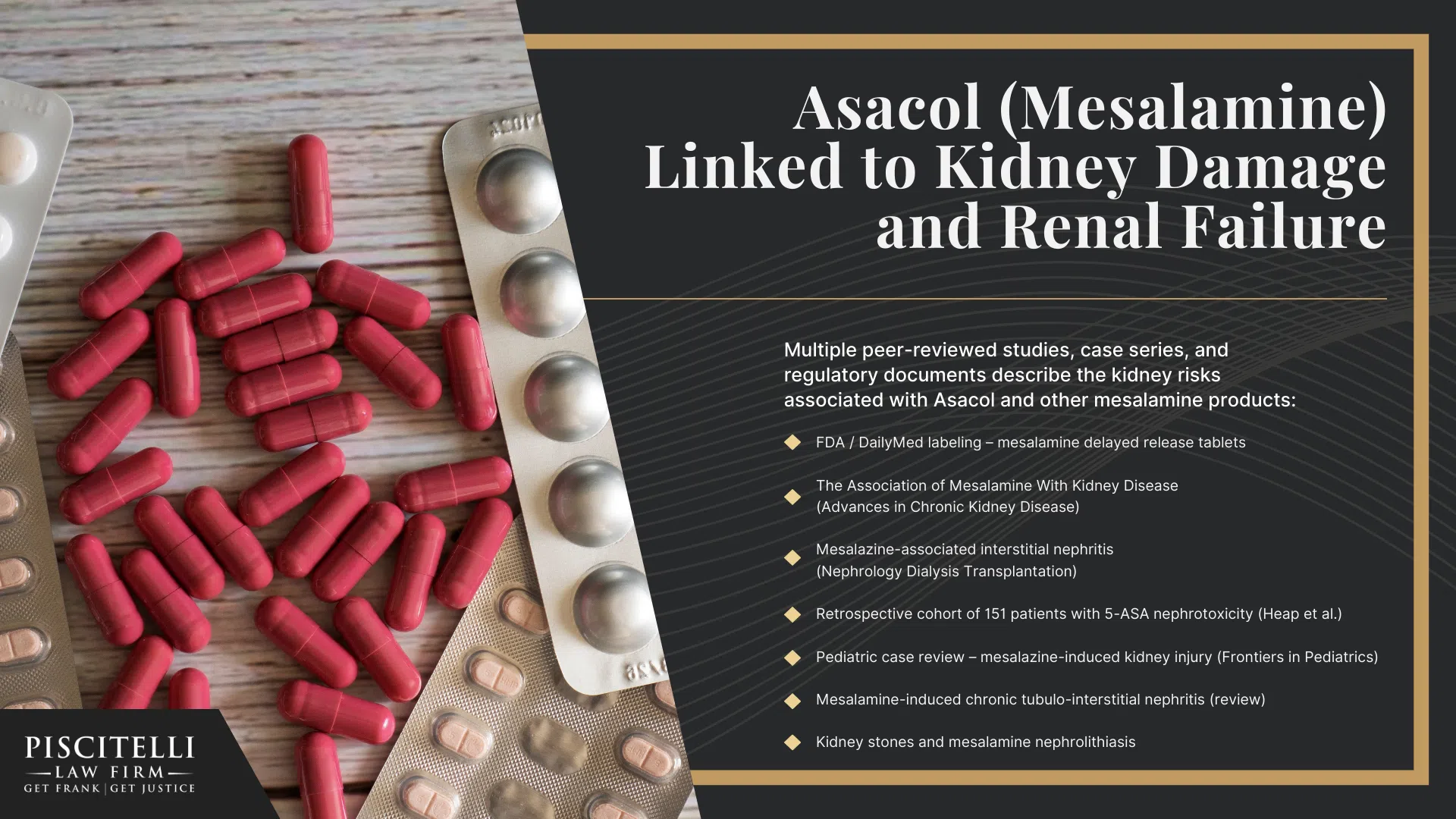
Multiple peer-reviewed studies, case series, and regulatory documents describe the kidney risks associated with Asacol and other mesalamine products:

  • FDA / DailyMed labeling – mesalamine delayed release tablets: Package inserts for mesalamine delayed release tablets, including Asacol and similar products, state that renal impairment (including minimal change nephropathy, acute and chronic interstitial nephritis, and renal failure) has been reported in patients treated with these drugs. The labeling instructs clinicians to assess renal function at the start of therapy and periodically during treatment, and to discontinue the medication if renal function deteriorates.
  • The Association of Mesalamine With Kidney Disease – (Advances in Chronic Kidney Disease): This review summarizes suspected adverse reaction reports and clinical data linking mesalamine to adverse kidney effects, including chronic interstitial nephritis and chronic kidney disease. It notes that product labels consistently warn of renal impairment and that nephrotoxicity is often detected only when serum creatinine rises on routine labs, underscoring the need for regular renal function monitoring in patients treated with 5-ASA.
  • Mesalazine-associated interstitial nephritis – (Nephrology Dialysis Transplantation): A classic paper reviewing cases of mesalazine-associated interstitial nephritis found that renal impairment of any severity may occur in up to 1 in 100 patients, while clinically significant interstitial nephritis occurs in fewer than 1 in 500 patients. When diagnosis of nephrotoxicity was delayed for 18 months or more after treatment began, restoration of kidney function after drug withdrawal did not occur, leaving many patients with permanent loss of function.
  • Retrospective cohort of 151 patients with 5-ASA nephrotoxicity (Heap et al.): A retrospective study of 151 patients with inflammatory bowel disease and definite or probable 5-ASA–associated nephrotoxicity reported that only about 30% fully recovered kidney function after stopping the drug, while nearly 10% required renal replacement therapy (dialysis or transplant). Longer duration of 5-ASA therapy and higher average dose were associated with more severe and permanent renal damage, illustrating how prolonged exposure worsens outcomes.
  • Pediatric case review – mesalazine-induced kidney injury (Frontiers in Pediatrics): A pediatric case report and literature review on mesalazine-induced kidney injury in children with inflammatory bowel disease found that kidney injury often presents with abnormal urinalysis and can progress to end-stage renal disease in a subset of cases. The authors emphasize that renal function should be monitored regularly in pediatric patients receiving mesalamine and note that at least 10% of patients with mesalamine-induced interstitial nephritis progress to end-stage renal disease.
  • Mesalamine-induced chronic tubulo-interstitial nephritis (review): A review of mesalazine-induced interstitial nephritis reported that, although overall nephrotoxicity in 5-ASA-treated patients is rare, about 61% of affected individuals are left with residual chronic renal insufficiency and approximately 13% develop end-stage renal disease. The authors describe most cases as idiosyncratic, not strictly dose-dependent, and often detected late because symptoms are nonspecific or absent.
  • Kidney stones and mesalamine nephrolithiasis: Pharmacovigilance reports and a case series describe kidney stones composed of mesalamine in patients treated with the drug, as well as radiolucent mesalamine stones that can be missed on standard imaging. These reports identify mesalamine-related kidney stones as an additional form of renal involvement, particularly in patients with long-term or high-dose exposure.

Types of Kidney Injury Linked to Asacol/Mesalamine

Asacol and other mesalamine products are associated with several forms of kidney injury that can develop gradually and silently in patients who rely on these medications for long-term management of inflammatory bowel disease.

Medical literature shows that many individuals experience renal complications only after prolonged exposure, especially when their doctors do not perform routine bloodwork to track serum creatinine or declining kidney function.

The drug’s toxicity most often appears as inflammation in the kidney’s tubulointerstitial compartment, but additional patterns of injury have been documented in both adult and pediatric patients.

Some patients develop sudden renal symptoms, while others learn of kidney damage only when testing reveals advanced impairment.

Once these injuries progress, especially in the absence of consistent monitoring, the resulting kidney disease can become permanent.

A subset of patients ultimately experience kidney failure requiring dialysis or transplant.
Asacol (Mesalamine) Linked to Kidney Damage and Renal Failure; Types of Kidney Injury Linked to Asacol_Mesalamine

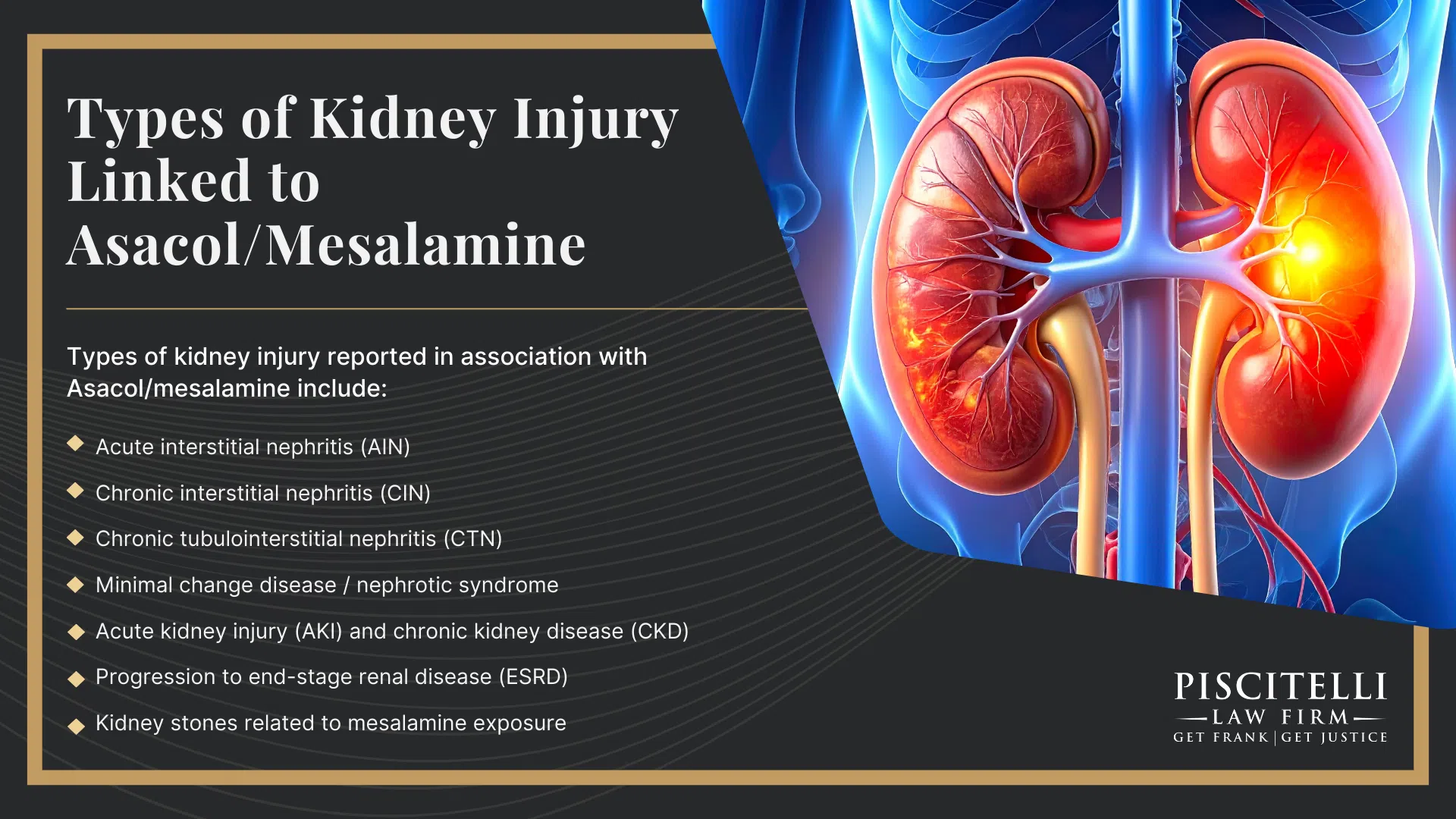
Types of kidney injury reported in association with Asacol/mesalamine include:

  • Acute interstitial nephritis (AIN)
  • Chronic interstitial nephritis (CIN)
  • Chronic tubulointerstitial nephritis (CTN)
  • Minimal change disease / nephrotic syndrome
  • Acute kidney injury (AKI) and chronic kidney disease (CKD)
  • Progression to end-stage renal disease (ESRD)
  • Kidney stones related to mesalamine exposure

Onset, Subtle Presentation, and Why Doctors are Supposed to Monitor Renal Function

Kidney injury associated with Asacol often develops slowly, which makes early detection difficult without appropriate monitoring.

Adult patients taking mesalamine may feel generally well even as their kidney function declines, because early renal impairment rarely produces noticeable symptoms.

Many cases are identified only after routine bloodwork shows elevated creatinine or reduced glomerular filtration rates, and in some instances, kidney biopsies performed later reveal advanced inflammation that had been progressing quietly for months or years.

This pattern contributes to situations where mesalamine toxicity is recognized too late, allowing reversible injury to evolve into chronic damage that rarely returns to baseline.

Because renal failure is rarely immediate and early warning signs are subtle or absent, the burden falls on physicians to order baseline tests, perform scheduled lab monitoring, and respond quickly to any signs of decline.

When doctors fail to monitor renal function as expected, patients lose the opportunity for early intervention and face permanent kidney complications that could have been prevented with proper oversight.


The Piscitelli Law Firm Has Secured Major Results for Victims of Asacol Malpractice

The Piscitelli Law Firm has developed a strong record of success representing individuals harmed by physicians who failed to monitor kidney function while prescribing Asacol.

Frank Piscitelli has handled multiple Asacol malpractice claims, each involving patients whose kidney damage could have been prevented with proper medical oversight.

The firm’s results in these cases range from $2 Million to $5.8 million for individual clients, reflecting the severity of the injuries and the long-term consequences of permanent renal damage.

These recoveries demonstrate the firm’s ability to present complex medical evidence, establish deviations from the standard of care, and prove the link between delayed diagnosis and irreversible kidney injury.

Asacol (Mesalamine) Linked to Kidney Damage and Renal Failure; Types of Kidney Injury Linked to Asacol_Mesalamine; The Piscitelli Law Firm Has Secured Major Results for Victims of Asacol Malpractice

The most recent result secured by Frank Piscitelli was a $2 million recovery for a victim whose kidney function was permanently compromised after their doctor failed to monitor lab values during Asacol therapy.

Through detailed case workup and focused trial preparation, the firm continues to hold negligent medical providers accountable for preventable harm.

For patients facing lifelong renal impairment, these outcomes provide vital financial support for ongoing treatment, transplant evaluation, and reduced quality of life.

Asacol Medical Malpractice Lawsuit: Do You Qualify?

Patients may qualify for an Asacol medical malpractice lawsuit if they were prescribed the medication and their doctor failed to perform routine kidney function testing before or during treatment.

Many qualifying cases involve individuals whose kidney damage went undetected for months or years because no one monitored their creatinine levels or evaluated abnormal lab results.

You may also qualify if you developed acute interstitial nephritis, chronic kidney disease, or reduced kidney function after taking Asacol and were never warned about the need for regular renal monitoring.

People who were young, otherwise healthy, or treated for inflammatory bowel conditions often assume their kidneys will recover once they stop the drug, but permanent injury is common when monitoring lapses occur.

Asacol (Mesalamine) Linked to Kidney Damage and Renal Failure; Types of Kidney Injury Linked to Asacol_Mesalamine; The Piscitelli Law Firm Has Secured Major Results for Victims of Asacol Malpractice; Asacol Medical Malpractice Lawsuit_ Do You Qualify

A claim may be appropriate if your physician continued prescribing Asacol despite worsening kidney values or failed to refer you to a specialist once renal impairment was suspected.

Patients diagnosed through kidney biopsies or emergency evaluation often discover the problem far too late to prevent long-term harm, which may strengthen a malpractice case.

You may also qualify if delayed diagnosis led to dialysis, transplant evaluation, or chronic kidney disease that now requires lifelong care.

An attorney can review your medical records, treatment history, and lab results to determine whether medical negligence caused your preventable kidney injury.

Gathering Evidence for an Asacol Medical Malpractice Claim

Strong evidence is essential in an Asacol malpractice case because the core issue is whether a doctor failed to monitor kidney function despite clear medical expectations.

These cases rely heavily on medical records that show how long the patient was on Asacol, whether labs were ordered, and when renal impairment first appeared.

Demonstrating delayed diagnosis or missed opportunities for intervention helps establish that permanent kidney damage could have been prevented.

Thorough documentation allows an attorney to reconstruct the timeline of negligence and prove the connection between Asacol exposure and the patient’s renal injury.

Asacol (Mesalamine) Linked to Kidney Damage and Renal Failure; Types of Kidney Injury Linked to Asacol_Mesalamine; The Piscitelli Law Firm Has Secured Major Results for Victims of Asacol Malpractice; Asacol Medical Malpractice Lawsuit_ Do You Qualify; Gathering Evidence for an Asacol Medical Malpractice Claim

Evidence for an Asacol malpractice claim may include:

  • Complete medical records from the prescribing doctor and treating providers
  • Lab results showing creatinine, BUN, eGFR, and urinalysis values over time
  • Pharmacy records confirming Asacol dosage, duration, and refills
  • Imaging studies or kidney biopsies documenting renal damage
  • Hospital records from emergency visits or inpatient treatment for kidney issues
  • Expert medical opinions identifying deviations from the standard of care
  • Correspondence or clinical notes showing missed follow-up or ignored lab abnormalities

Possible Damages in Asacol Malpractice Cases

Damages represent the financial and personal losses a patient suffers after preventable kidney injury caused by negligent medical care.

In Asacol malpractice claims, damages help account for the long-term medical needs, reduced quality of life, and financial strain that follow permanent renal impairment.

These losses often continue for years, especially when patients require ongoing monitoring, dialysis, or transplant evaluation.

A successful claim can provide compensation that reflects both the immediate and lifelong consequences of untreated kidney damage.

Asacol (Mesalamine) Linked to Kidney Damage and Renal Failure; Types of Kidney Injury Linked to Asacol_Mesalamine; The Piscitelli Law Firm Has Secured Major Results for Victims of Asacol Malpractice; Asacol Medical Malpractice Lawsuit_ Do You Qualify; Gathering Evidence for an Asacol Medical Malpractice Claim; Possible Damages in Asacol Malpractice Cases

Possible damages in Asacol malpractice cases may include:

  • Past and future medical expenses
  • Costs related to dialysis, transplant evaluation, or long-term treatment
  • Lost wages and reduced earning capacity
  • Pain and suffering
  • Loss of normal life or diminished quality of life
  • Costs of disability accommodations or assistive care
  • Emotional distress resulting from chronic health complications

Piscitelli Law Firm: Contact an Asacol Malpractice Lawyer Today

Permanent kidney damage from Asacol is often preventable, and patients harmed by a doctor’s failure to monitor kidney function deserve answers, accountability, and meaningful support.

If you developed renal impairment, chronic kidney disease, or other complications after taking Asacol, you should not wait to speak with an attorney.

Delays can affect both your health and your ability to file a claim.

Piscitelli Law Firm has extensive experience with Asacol malpractice cases and understands the medical and legal issues involved in proving these complex claims.

Frank Piscitelli is prepared to review your records, evaluate whether negligence occurred, and guide you toward the compensation you need for long-term care and stability.

Asacol (Mesalamine) Linked to Kidney Damage and Renal Failure; Types of Kidney Injury Linked to Asacol_Mesalamine; The Piscitelli Law Firm Has Secured Major Results for Victims of Asacol Malpractice; Asacol Medical Malpractice Lawsuit_ Do You Qualify; Gathering Evidence for an Asacol Medical Malpractice Claim; Possible Damages in Asacol Malpractice Cases; Piscitelli Law Firm_ Contact an Asacol Malpractice Lawyer Today

Contact the Piscitelli Law Firm today for a free consultation and learn whether you qualify for an Asacol medical malpractice lawsuit.

Frequently Asked Questions

Published by:
Share
Picture of Frank Piscitelli
Frank Piscitelli

Member of the Ohio State Bar Association since 1993. With 30+ years of legal experience, Attorney Frank Piscitelli has secured over $55 million in compensation for Ohio injury victims, car accident victims, and surviving family members of Ohio wrongful death victims.


This article has been written and reviewed for legal accuracy and clarity by the team of writers and attorneys at Piscitelli Law Firm and is as accurate as possible. This content should not be taken as legal advice from an attorney. If you would like to learn more about our owner and experienced Ohio personal injury lawyer, Frank Piscitelli, you can do so here.

Piscitelli Law Firm does everything possible to make sure the information in this article is up to date and accurate. If you need specific legal advice about your case, contact us. This article should not be taken as advice from an attorney.

Additional Resources

Do you have a case?

A serious injury can have life-altering results.

Don’t settle for less than you deserve, speak with an award-winning personal injury lawyer today.

53 Reviews
4.9
★★★★★
Recovered damages
$50 Million+

Table of Contents

Practice Areas
About Piscitelli Law

For 30 years, Frank Piscitelli has been fighting for clients who have been the victims of the wrongful death of a loved one.

Do you believe you’re entitled to compensation?

Use our Instant Case Evaluator to find out in as little as 60 seconds!

Guides & Resources
Edit Template